Working on Lightning’s returns (with video)

I was lucky enough to have two assistants a couple of days ago, so I used one to take some videos while the other one acted as gunner, and tried my hand at editing one of the videos. This one shows Lightning running a single and a momma-poppa double (that is, one gunner throwing both marks) after we’d gotten Lightning to the point that day of being able to return without playing keep-away. At that point, he’d been training for about an hour, but luckily the weather was cool so we still had plenty of dog.

This particular video is not especially instructive, but I guess it’s a chance to see what Lightning looks like these days.

Using -P for keep-away

Lightning seems to be back in excellent health, and in a couple of days he’ll be fifteen months old, so here’s an update. For weeks now, my assistants and I have been trying a variety of methods to address a problem in Lightning’s performance so serious that no further progress in Lightning’s training was possible till the problem was resolved: Lightning’s tendency to go into a game of keep-away rather than returning with the article during a retrieve. He stopped doing it some time ago with 2″ bumpers as long as they didn’t have ropes, but it has been a maddening problem for any bumper with a rope, as well as 3″ bumpers even with no rope, to say nothing of dokkens and birds.

We’ve tried many methods to address the issue, variations of running Lightning on a long line, using many kinds of positive reinforcement for correct performance, and even running Lightning and Laddie simultaneously to bring out Lightning’s competitive streak. We’ve met with some success with several of the approaches. But none was able to produce consistent results.

Finally yesterday I came up with a way to add negative punishment to the mix. In the science of operant conditioning, negative punishment, abbreviated “-P” or “P-“, means causing a behavior ( an undesired response) to become less probable by removing reinforcement, or by removing the opportunity for reinforcement, when the behavior occurs.

Here’s the method I came up with: My assistant and I stand some distance apart, but both about the same distance from my van. One of us handles Lightning, the other acts as gunner and throws bumpers. If Lightning returns to the handler with the bumper, he receives one or more kinds of reinforcement, such as a bite of a cheeseburger (no bread), or a tossed toy or bumper. Then the handler calls him to heel for another retrieve.

But if Lightning picks up the bumper and goes into keep-away mode, the handler calls out “Stop” and then both the handler and the gunner start walking toward the van. Lightning may continue to run around with the bumper for awhile, but soon he realizes he’s alone out there and brings the bumper to the handler. The handler reinforces that delivery in some way and we all go back to setting up for the next retrieve.

Once I had worked out the basic approach in my mind, I planned to use it with 100% constituency for several sessions, in the hope that Lightning would eventually learn the no-reward-market (NRM) “Stop”, and gradually learn to avoid it and the associated -P of having the retrieve game stop, by making good returns. I thought it might take a week or so before we could evaluate whether it was working, that is, whether correct responses were becoming noticeably more probable than incorrect responses.

Well, it took a lot less than that; it took about five trials. The first few times we used it didn’t seem to make any difference, and Lightning continued his annoying practice of going into keep-away mode after picking up the bumper. But soon he noticeably shortened the time he stayed in his  game before bringing the bumper to the handler who was on his way to the van, and finally he began bringing the bumper straight back to the handler after picking it up.

The progression wasn’t perfect. Lightning would display extinction bursts as he gradually tested the new rules, but by the end of the session, he was able to run a nice momma-poppa double with both retrieves over 100y. Of course we worked toward that setup incrementally from the original setup.

That was yesterday. This morning I went out with a different assistant and we used the same method again. Lightning needed to re-learn that keep-away would end the retrieve game, but it didn’t take long. By the end of today’s session, he was able to run a series of triples, with the gunner throwing a momma-poppa and the handler throwing the go-bird from the start line.

So far we’ve worked with 2″ and 3″ bumpers, all with ropes. Tomorrow we’ll try it with dokkens, and in subsequent sessions hopefully a time will come where Lightning won’t bother to go into keep-away mode with bumpers or dokkens at all. Then, hopefully, we’ll be able to use the method with thawed birds, and eventually, finally, flyers.

If all that goes as hoped for, we’ll be able to resume the steps of our PRT program. It will be too cold for water training till next spring, but we have plenty of land work to do, on both marked and blind retrieves and associated drills, in the meantime.

Dogs are all different, and I don’t have the data to know how other dogs who stop bringing the article back would respond to this -P solution. But hopefully it will prove to be a useful tool for some of them at least. It’s been invaluable for Lightning’s training.

Update: Although all dogs are different, and the method described in this post might work for some retrievers, it turns out that it was not successful for Lightning over the long haul.

What happened was that as each day went by using this approach, Lightning became increasingly likely to go into sustained keep-away mode. The tendencies were subtle, so it took a few days to realize what was happening. But eventually it was clear that this approach was having the opposite of the desired effect.

I’m not sure why. It may be that Lightning became less concerned about me stopping the retrieve game, as he learned that we always resume once he was done playing keep-away. Or it could be that the more keep-away he played, the more reinforcing it was, gradually outweighing in value the retrieve game.

Thus, at least for Lightning, the -P method described in this post was a bust, possibly even setting Lightning further back.

This has been the challenge of developing a new training method. Sometimes you need to test a false path to discover it won’t work it.

However, in a later post, I’ll describe an alternate method I’ve come up with, using both a long line and a rubber ball, that has been far more effective.
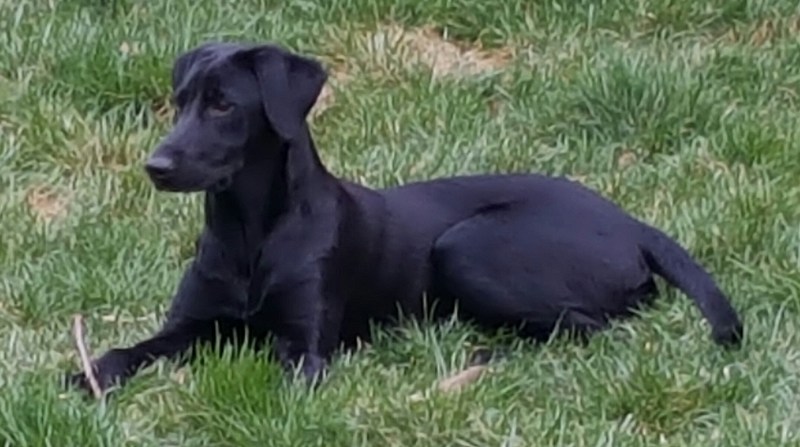
Lightning at fourteen months

Based on Lightning’s earlier progress, I thought he would be further along in his retriever skills now that he’s reached fourteen months of age, and has been with me a solid year. But actually, he went backwards in his training a few months ago and we’re only partway to recovering.

Some of the reason, I think, was because of health issues. Lightning developed a serious bacterial infection several months ago that caused hair loss on his entire undercarriage, as well as some larger lesions on his right wrist and elbow. When the first antibiotic prescribed by the vets didn’t work, we got a lab test that showed the infection was resistant to almost every antibiotic in use for dogs. But we began a second antibiotic, one of the few to which the infection is susceptible, though so risky for side effects that I was required to wear gloves when handling the tablets.

Two courses of that, along with a number of other sprays, shampoos, and ointments, made good progress in fighting the infection, but Lightning wasn’t allowed to swim for months. That was unfortunate timing for his training given that we can’t swim around here when the weather is too cold, so he’s lost nearly a year of water training. But that wasn’t the only problem.

It turns out the new antibiotic affected Lightning’s liver function, which apparently lead to nausea, which lead to a loss of appetite, which lead to weight loss. Already tiny and skinny, he dropped another three pounds, getting down to 41lbs in weight. Of course we stopped the new antibiotic immediately and began a new medication which, after several weeks, seems to have repaired Lightning’s liver function.

His appetite, however, is not completely restored, though he never really did have much of an appetite. The weight loss issue put me in the middle of a disagreement between the two veterinary practices I use, both of whom I highly respect. At the conventional practice, one of the vets blamed Lightning’s weight loss on his raw diet, which was true to the extent that Lightning’s nausea made raw food unappealing, but the best also attributed other problems to feeding raw, which IMO he had no evidence for. Like many conventional vets, the vets in that practice don’t think well of raw diets. So he directed me to switch to kibble, which indeed Lightning was more willing eat, provided I hand fed him.

But when I brought Carol, my holistic vet, up-to-date on Lightning’s condition, she disagreed pretty adamantly with feeding Lightning kibble. I don’t see how it can be that bad, since many dogs, including performance dogs, seem to thrive on kibble. But I place my trust in Carol and she said that if Lightning wouldn’t eat the frozen raw food he used to eat, which didn’t surprise her given his liver condition, I should feed him home-cooked or commercially cooked raw food. Carol doesn’t like microwaves, but I’ve gradually developed ways of preparing the food, using both a microwave and a stove-top skillet, that make the food palatable to Lightning. As his liver recovered, his appetite has partially returned and he sometimes eats his raw food frozen as before. The rest of the time, I cook his food and he’ll usually eat that, though sometimes again only if I hand-feed.

Carol also had me start Lightning on a probiotic and an herbal supplement, both powders. And since Lightning’s lesions still weren’t completely healed, I took him to a veterinary dermatologist. The specialist was supportive of all the previous treatments Lightning had received, but changed us to a new group of medications that he seemed pretty confident would complete Lightning’s recovery. Indeed, Lightning’s undercarriage is now healed with most of the fur grown back, and the lesions on his wrist and elbow are on the mend. He’s also allowed to swim now, but it’s pretty much too late for water training around here till next spring.

As for how all this affected Lightning’s land training, that’s difficult to say. Everything was going well a few months ago, as we completed PRT Stage 2 and began Stage 3, corresponding to Transition in traditional programs like Mike Lardy’s TRT. However, suddenly Lightning’s returns fell apart. He could mark well on both singles and doubles at good distances and with the introduction of some factors such as hills and strips of cover, but he stopped bringing the article back. Instead, he’d pick it up, often carrying it incorrectly such as by the rope, and run all over the field and into the woods, ignoring all his trained cues and playing keep away if I approached. He’d tear up birds.

The road back has been long and arduous. Among the many methods I’ve tried to resolve the issue:

  • Reinforcement for returning with bites of deli meat I tis to him after a nice delivery
  • A long, 60′ line along with short, 20y throws so that I can hang on and reel Lightning in if he gets the zoomies
  • A short, 15′ line attached to his collar, along with increasingly longer throws; apparently, this sometimes seems to make Lightning believe that he won’t be able to get away so he makes a good return, but unfortunately it doesn’t always work
  • Cessation of most yard work, though I do throw in a cold blind of around 100y from time to time; my feeling is that, besides health issues, some of Lightning’s behavior was the result of stress caused by the additional complexity of training on both marks and blinds simultaneously, so I’m trying to eliminate stress as much as possible for now, though he seems to enjoy the occasional blind and that’s let us practice a bit on whistle sits and casting
  • Training with simpler articles such as 2″ white bumpers with the ropes removed, then adding increasingly complex articles, including dokkens, in a series of marks at varying distances; I’ve also tried birds but he still won’t carry them properly, though he had learned to when he was younger

This is very much a work in progress, with good days and bad days. The good days encourage me that soon we’ll be able to resume progress on our planned PRT program, to further develop his skill in land marks and blinds, plus water retrieves in the spring. On the other hand, the bad days are frustrating and discouraging. I don’t have a crystal ball; I wish I did. For now, I’m just trusting that eventually the good days will win out.

Medical issues trump training

Once when Lumi, my first Golden, was two years old and we were competing in agility, she ran up a teeter at a practice session, apparently thinking it was a dog walk, and was unprepared when it dropped out from under her. Although she had always loved the sport, she didn’t want to go near a teeter again after that.

With advice from other trainers, I tried for months to solve the issue as a training problem using a wide variety of methods. At last I learned from a sports medicine vet who we began seeing that Lumi had a chronic wrist injury, possibly dating from that very incident. No amount of training was going to compensate for the fact that running the teeter caused her significant physical pain as the teeter banged against the floor. Lumi’s agility career was over. That’s when we switched to field work.

Fast forward a few years. Now Laddie, my second Golden, and I were at a training workshop a year ago and Laddie began to exhibit some odd behaviors. He’d chew grass when I stopped him with the whistle, and after retrieving a bird at one point, he tried to bring it to his crate in the van rather than to me at the start line. On a water drill, he repeatedly took wrong lines when sent, avoiding the water, until finally one of the other trainers noticed a subtle irregularity in his gait. Luckily I pulled out of the workshop rather than trying to fix what looked like a training issue. An orthopedic specialist told me a couple of days later that Laddie had a groin injury and said he might need months of treatment and rehabilitation. Luckily he only needed a few weeks of rest. What he didn’t need was me trying to address his strange behaviors as a set of training issues.  Those problems disappeared once he was healthy.

So you’d think I’ve learned by now, but unfortunately sometimes these cases only look obvious after you figure them out.

In particular, for some time lately, Lightning’s returns have fallen apart, with him playing games of keep away, dropping the bird at the line when I cued Heel, and other avoidance behaviors. Yeah, just like an untrained dog. He wasn’t too bad with a bumper, but I couldn’t fix the problem with birds no matter what I tried. Then this week I learned that he currently has a liver problem from a long course of antibiotics he’s been on for a staph infection, and today I learned, furthermore, that liver problems can make a dog nauseous.

I immediately realized that that’s why Lightning started refusing his normal diet of raw meat several days ago and would only eat other items, in some cases only if I hand-fed him. It took hours more, and a long, enlightening conversation with my dear friend Jody Baker, before I realized something else.

Lightning hasn’t forgotten how to retrieve. Rather, retrieving was making him feel sick, especially picking up limp, cold ducks. He didn’t want to bring a duck back to me, even if he could stand to carry it, because I’d throw it for him again.

As in the previous incidents with my other dogs, what looked like a training issue turned out to be a medical issue, and no amount of operant conditioning, positive or otherwise, was going to fix it.

OK, as a trainer, you don’t want to constantly be making excuses for your dog. Often behavior lapses are in fact training issues. But what these examples had in common was the oddness of the lapses: my dogs suddenly refusing to perform behaviors they had not only previously learned, but had always seemingly previously loved. They suddenly were acting like untrained dogs.

I will confess to a feeling of guilt in all these cases. I didn’t listen to my dogs when they tried to tell me they were hurting, and I let them down by trying to “train” them past their injuries. I guess I won’t dwell further on how this makes me feel about myself. But I hope I’ll learn to recognize the difference between medical issues and training issues sooner in the future.  I’d hate to make that kind of mistake again.

Preparing for workshop

Several weeks ago I signed up Laddie and Lightning for a five day training workshop in Tennessee with an excellent pro there. Today I’ll drive there with the pups, since the workshop begins tomorrow.

But I think I’ll withdraw Lightning from participation. He’s been fighting a staph infection for a couple of months and isn’t allowed to swim. Meanwhile, I’ve also suspended training himon handling until his returns on marks become reliable again.

In our daily training sessions, I run him on walking singles, singles off multiple guns, and doubles depending on how many assistants I have. The quality and consistency of his returns depend on the articles we’re training with. He’s fine with 2″ bumpers, fairly good with 3″ bumpers with streamers, not too bad with duck dokkens, less reliable with pheasant dokkens, and completely unreliable with partially thawed birds. 

That level of performance, plus the restrictions on what he can work on, mean, I think, that he’d get little benefit from the workshop. So sadly, he’ll have to spend most of the next week in his crate in the back of the van. I’ll take him out as often as possible to exercise him and run him on poorman marks, anyway.

Meanwhile, I’ve entered Laddie in a trial next Saturday in Virginia. I’m hoping that the workshop will prepare him well for the trial. I’m also hoping my own physical and mental condition are up to all that driving and the long days of training and competing. I guess we’ll find out.

Reducing stress to strengthen the return

Until this point, the Positive Retriever Training (PRT) I’m developing has closely followed Mike Lardy’s traditional Total Retriever Training (TRT) every step of the way through Mike’s Basics stage and PRT’s Stage 2. Now it’s time for PRT’s Stage 3, modeled on Mike’s Transition stage in TRT.

Actually, Lightning has not yet completed the swim-by drill, the last step of PRT Stage 2, because of logistic issues, but we’ll get to that as opportunity permits.

Meanwhile, however, continued work with Lightning on PRT Stage 3 handling drills, in parallel with continued development of marking skills, had been interrupted by a confusing phenomenon: Lightning, just having turned a year old, and despite a thorough foundation in carefully sequenced training objectives, has suddenly become unreliable on his returns. Sometimes he runs a nice retrieve, whatever the setup we happen to be working on. Other times he completes the outrun well, but then picks the bumper or dokken up by its rope and darts off in the wrong direction, sometimes embarking on a merry chase all over the field, completely immune to whistle or verbal cues. He looks like a complete beginner. It’s difficult to believe this is the same dog who was running the double T and 300y marks without such misbehavior a few weeks ago.

After much thought and seeking of solutions, not necessarily a waste of time but not fully resolving the issue, I’ve begun to focus on a comment my friend Jody Baker made when I introduced the issue of zoomies some time ago. Based on her work with dogs in other sports such as agility as well as field work, Jody commented that stress can be a major factor in why such behavior occurs.

Pursuing that line of thought, I’ve recently experimented with temporarily terminating Lightning’s training on handling and instead used all of our training time for marking practice. After some initial remedial measures, such as having Lightning wear a long line and using food for reinforcement of good returns, Lightning’s returns are gradually improving. The last two days, he did a number of singles and doubles, including a couple of retired singles, mostly with solid returns.

Based on this experience, combined with extensive previous experience with Lumi and Laddie when they were at the same stage in their training, I’ve come to the conclusion that PRT Stage 3 should diverge from TRT Transition in a significant way. I’m particular, PRT Stage 3 should begin with the focus entirely on marking, enabling the dog to develop a far stronger positive association with high quality returns than he/she had developed up until this time. Those returns need to be trained not only as a skill, but as a deeply embedded motor pattern that can withstand the disruption of stress when it starts to become part of the dog’s training for handling.

The reason that this isn’t an issue in TRT and other traditional programs is, I believe, because the ecollar is used to enforce a quality return. Stress or no stress, the cost to the dog of a poor return is too high a price to pay.

But for a positive trained dog, no price is extracted for a poor return. It is entirely the dog’s choice. Perhaps a treat is withheld or a long line is used to enforce the return, but to the extent that the dog is able to express his/her preferred behavior, a return directly to the handler with the article ceases to become the dog’s first choice once stress issues start to become associated with the work. Zoomies become a way to avoid and dissipate stress. And as trainers, we don’t want that behavior chain to become entrenched.

Fortunately, it appears that the behavior can be reversed by terminating the parallel stressful training  (diversion drills, for example) and focusing all our training on marking skills. The idea is that, after some period of time, solid returns will become so deeply embedded in the dog’s behavior that training of handling skills can resume without losing the dog’s ability to perform high quality returns.

This is a fundamental change to PRT as I’ve been presenting it, and this change means that Lightning’s training is not a perfect example of PRT training, since Lightning and I have engaged in training handling apparently before Lightning was ready. Hopefully I and others using PRT for other dogs will avoid this mistake by deferring the introduction of stressful drills until the dog’s marking and return skills are more extensively practiced.

Accordingly, I will sort this post out of order in the Table of Contents so that the reader will encounter this discussion before reaching the posts on training objectives I now think should be deferred. I’ll also try to develop a sort of litmus test for how to judge when it’s time to begin the handling drills. At this writing, I don’t yet know what that test is.

Wagon wheel

As Lightning’s PRT Stage 3 continues, our next task has been training the wagon wheel drill that Mike Lardy describes for the Transition stage of TRT. The PRT version is virtually identical, the only difference being that I work on Lightning’s line mechanics, including as required for the wagon wheel, with no lead or other physical connection between us.

The first day of our work in the wagon wheel, Lightning was able to pick up a circle of eight 2″ white bumpers with no errors. So starting on the second day, we began working on him picking up a 2” red bumper on a line between two 2″ white bumpers tossed into place after the red bumper was tossed. That was much more difficult, and required repeated use of “no, here” as in the no-no drill we’ll be working on after the wagon wheel.

Obviously the wagon wheel has great value in developing communication between handler and dog, line mechanics, and lining skill. As Mike explains in the TRT video, introducing “no, here” in a gentle, non-aversive way will also provide value to later training tanks.

However, after watching Lightning’s behavior on retrieves, both in these drills and in separate marking practice at this time in his development, I have come to believe that the work we have been getting into, especially the diversion drill and now the wagon wheel, are more stressful for Lightning than I had previously understood,  so we’re going to set aside his training on handling skills for now.

I’ll discuss that topic further in a separate post, which I’ll sort into the Table of Contents out of order and earlier once I’ve completed it.

Meanwhile, when the time comes to return to the wagon wheel, we’ll continue until Lightning is comfortable with the entire 16-bumper configuration as well as with “no, here” as a gentle, non-aversive cue for use on a poor initial line and later analogous situations.

As a final point, when I say non-aversive, I don’t mean to say that “no, here” doesn’t function as an aversive, because it does. Retrievers don’t like being called back, and will alter their behavior to avoid it happening. But the aversive quality of the cue comes from the fact that the dog is losing the opportunity to complete the retrieve, not from the way the cue itself is expressed by the handler. A neutral or even cheerful “no, here” is just as effective as a correction to an incorrect response, terminating that trial and setting up for the next one.

Late summer logistics

Here’s a recent conversation with my internet friend Patrice, which she asked me to preserve on Lightning’s blog for possible future readers:

Patrice: This is something I’d like you to write several blog posts on — how do you organize your life, space, and time so that you can train as much as you do? You work full time, right? Lack of nearby space, and working full time are my biggest impediments, especially in the shorter days of winter.

Me: Hi Patrice. I’m not sure I have enough for several blog posts, but here’s a try: Yes, I work full-time, a GS-14 for Treasury. I also work an average of 50 hours a month building a software app for a client, as my side job. I have virtually no social life, have pretty much given up TV, and can get along on small amounts of sleep when I need to. I apparently have a mild version of Asperger’s, which may account for unusually high focus and endurance with annoyingly infinite attention to detail. I work at home most days and have great flexibility in my hours, though these days doctors visits are taking a ridiculous amount of time. I love my wife, my kids, and my friends, truly I do, but since Lumi, my life is really about my dogs. Typical day in any particular time frame would look very different, but typical day until my latest bout of leg injury: up at 4am, get ready for day, drive 30-60 minutes picking up assistant(s), drive 60+ additional minutes to/from training location, 2-4 hours training, drop off assistant(s). I’ll spend additional time on dogs each day for things like trimming nails, playing fetch, cutting up raw food, etc., but that’s about all the time we have for training on weekdays. In bed (with dogs) around 10pm. Not unusual to train virtually all day on Saturday and/or Sunday as well as any holiday, counting events, workshops, and club training days as “training”. As for locations, I do have access to several excellent training grounds within about two hour radius, generally too far. But I’ve found dozens of fields, construction sites, parks, etc., over the years where I can take the dogs and my assistants to train, depending on what we’re working on as well as weather, and also accommodating my assistants’ schedules. I think schedules and other circumstances are highly individual and question whether knowing mine would help anyone. Virtually every successful trainer I know sends at least some of their dogs to pros at least some of the dogs’ careers, largely because of time though of course they also want their dogs to get quality training. All this makes a high demand on time and finances. In addition, at least for me, the demand on emotions is just as high. Anyway, does any of this help, or would more detail about anything be useful?

Patrice: Lindsay, nice try. I want at least one blog post so the information won’t get lost in the bowels of Facebook. I’ve been wanting this ever since I started reading your blogs. Please. I’ve always thought that the logistics are at least as important as the methods and practice. (It must change seasonally, right?)

Me: OK, Patrice. Was that post about the right amount of detail? I’ll try to make it a regular feature. I’m sure others also interested since important to you.

Poorman doubles and triples

In PRT Stage 3 as in Stage 2, the dog’s training is divided into parallel paths: combinations of land and water, marks and blinds, and various goals for each. On a given day, you might wish you could work on water handling, but you don’t have access to a technical pond that day. Similarly, not having an assistant constrains you on running marks or diversion drills.

But one drill exists that a dog at any level can benefit from, a drill retrievers love once they understand the concepts. They may be able to play the game without losing motivation longer than you can, given that a lot of shoe leather is involved and I for one am going thru a stage of unfortunately low endurance.  It’s a good workout and great practice for the dog.

The drill is poorman marks. I’ve used poorman singles with Lightning for months, and now he’s able to do doubles as well. I did poorman triples with Lumi and Laddie for years, and I think Lightning may also be ready for triples soon if not already.

Here’s what a typical poorman double would look like:

  1. Bring Lightning to heel on a rubber mat. This is a skill he’ll need in competition, and it makes it clear to both of you if he creeps while you’re throwing.
  2. Cue Sit and walk out into the field carrying your pistol and two articles for throwing. I typical bring a combination of 3″ bumpers with streamers and dokkens in various types and colors. If Lightning creeps, I go back and reposition him.
  3. I usually throw the long mark first, but it’s good to mix them up. Of course I also alternate which direction I throw first. I might even throw both to the same side but at different distances.
  4. Walk back to the mat and run the dog on each mark. At this stage I always run Lightning on the go-bird first, but at some point I might mix that up occasionally as well.

As you can see, many important skills are incorporated into a poorman multiples drill:

  • Patience and steadiness at the line.
  • Good line mechanics on the sends.
  • Retired guns, thus learning to remember marks by background and other features, not just relative to where the gunners are.
  • Gaining comfort with the concept of multiples.
  • Perhaps the most important: developing ever increasing confidence that if you run to the exact spot you saw the bird land, it will be there when you arrive. Some dogs do not learn that lesson and instead run to the area of the fall and then begin to hunt, rather than trying to nail the mark. Lower scores are the result.

Of course many other options are available: occasionally throw into cover for practice and to make a hunt more likely; use stickmen to help dog learn to take advantage of that info; add factors such as cross wind, hills, and strips of high cover to introduce the dog to those as well. As they say, the only limit is your imagination.

Today I ran Laddie on a couple of nice blinds thru points of cover, then ran both dogs on a battery of poorman doubles at different distances. Even with temps in the high 70s, they were ready to keep working when I had to tell them I had had it for the day. Luckily they forgave me.

Lightning at a year old

Lightning is now a year old. He’s still 44lbs, and still  a joy. But a few weeks ago his training stalled in the early work of PRT Stage 3, corresponding to TRT Transition. We were in the middle of blind drills and diversion drills, where he was making good progress on those concepts, when his recall and returns abruptly began to fall apart. It may have been because I was using dokkens for the marks, I’m not sure. But it soon got to the point where he couldn’t come straight back even with a 2″ bumper.

I had no choice but to turn our focus to his returns. We trained nearly every day, though hampered by a typical assortment of factors: record warm temperatures, crippling pain in my ankles and knees, and limited availability of my assistants, who are now in college rather than high school. But we got a lot of work done and made gradual progress.

It’s a difficult topic to write about from an instructional view, because I don’t know whether your dog will even have this issue, and I’m pretty sure there’s no cookie-cutter solution that works on all dogs that do develop the problem, unless you want to depart PRT and begin using an ecollar. I think the one common solution is not to get frustrated and not to give up. Understand that this is probably the most difficult skill you’ll ever have to teach your dog, it’s hard, and it’s going to take time and patience.

That said, here are some of the things I’ve done that I believe proved helpful in Lightning’s return training:

  • Endless games of fetch, indoors, yard, and fields, with every available article. I occasionally ask for steadiness, but usually not. Lightning can play this game for dozens of fetches. It seems almost impossible for him to get tired of it.
  • Short walking singles with an assistant, with Lightning on a long line. I use lines of 15′, 30′, and 60′. Sometimes I throw, sometimes my assistant throws. We use a wide variety of articles, from 2″ bumpers with ropes, to 3″ bumpers with ropes and streamers, to duck and pheasant dokkens. If Lightning doesn’t bring the article back, the handler gently reels him in. He usually tries to grab the article to bring with him but it doesn’t matter whether he’s successful in that or not  He learns a useful lesson either way.
  • For reinforcement, I’ve used the heel and catch game, gunshots, and food. Overall I felt we made best progress with food, though you don’t have to use secondary reinforcement (the food) on every retrieve because the work itself still provides the primary reinforcement. If that’s not the case with your dog by this time, you’re probably not going to get much further IMO. But Lightning still makes noticeable improvement on his returns when I reinforce with food, and I feel it would be stupid for me to be too stubborn to realize that and refuse to leverage it.
  • Occasional marks without a long line mixed in during the walking singles. Finally, finally, a day comes when you can do a whole session with no long line, and just gradually build up some distance.

A few other nuances are involved, such as choice of terrain and so forth, but it’s really kind of boring to talk about. It’s just a lot of work and a lot of faith that it will eventually pay off. And indeed, finally it has done so with Lightning and we are nearly ready to resume our PRT Stage 3 training. I expect relapses, which we’ll address the same way. I may not always discuss them further in this journal.