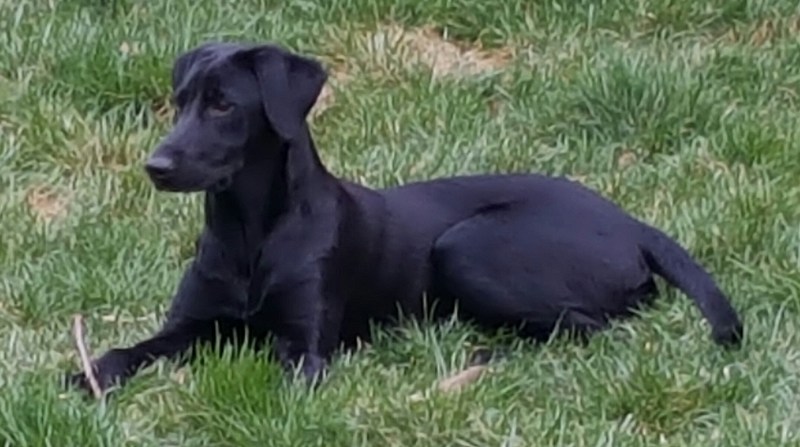
Heeling to the start line

Today, on our first day of Stage 2 training, I began teaching Lightning the formal pattern for heeling to the start line. Here’s how we went about it.

For equipment, you need:

  • High-value treats (I use sliced deli meat)
  • A holding blind
  • A rubber mat
  • Possibly a mallet to drive the holding blind’s posts into the ground
  • Your dog will wear both his/her training tab and a lead for walking. I use a British slip lead because it easily fits in my pocket while I’m running the dog
  • One bumper
  • You don’t need an assistant, but when you have one, he/she can play a judge

Now, using the treats for ample reinforcement, train the pattern you will use for heeling the dog to the start line. Trainers use a number of variations, but here’s the pattern I use, and I believe many others do as well:

  1. Start with an empty dog by airing your dog as long as necessary. Don’t waste a training or competition opportunity by trying to run a dog distracted by nature’s call, resulting in a subpar performance.
  2. Begin the sequence by walking the dog on lead to the center of the holding blind.
  3. The dog may spend several minutes in the blind, so use soothing words, petting, and so forth to make the wait comfortable. If it helps during training, you can also use treats for this process.
  4. In competition or a training day, use this waiting opportunity to watch the team in front of you and learn what you can from their work.
  5. At the same time, watch closely for any loose dogs that approach the holding blind. Protect your dog, and above all prevent a dog fight. If necessary, drop to your knees and wrap your arms around your dog. If the other dog gets too close, warn that dog in no uncertain terms, “GET OUT OF HERE!” If that embarrasses the dog’s owner, fine. More likely, he/she will be grateful for your diligence in preventing a fight that could lead to both dogs being eliminated from the event or even banned from the sport.
  6. When the judge invites you to run your dog, ask any questions you might still have.
  7. Now it’s time to bring out your dog. Cue “Sit”. Most people use a verbal cue, but some use a whistle.
  8. Remove the dog’s lead. In training, the dog is still wearing his/her tab until reliably steady.
  9. Leaving the dog in a sit, step outside the holding blind. Practice both sides. If you have a choice, choose the side that will give the dog the best view of the setup as he/she approaches the start line.
  10. While watching your dog waiting in the holding blind, stop a few feet away, turn your body toward the start line, and call your dog to heel. Again, practice both sides. Having the dog sit at heel is optional, but at this moment, you and the dog are now under judgment, so train this maneuver to be performed with some precision. I gave Lightning a piece of ham here. Practice until you can call the dog to heel from the holding blind and to your side with the two of you fully engaged with one another.
  11. Heel the dog to the start line, that is, the rubber mat a few feet in front of the holding blind. Sometimes it is quite close to the holding blind, but usually it’s several feet away. Again, you are under judgment and the dog needs to learn this maneuver with precision. I used ham for this step, too. Practice initially away from all distractions, then, over time, proof with the greatest distractions you can arrange. Reinforce correct behavior amply, but if the dog breaks away when training this maneuver, gently put on the dog’s lead, return to the holding blind, and start again. Practice heeling the dog to attain fluency on either side.
  12. Heel the dog onto the mat and cue Sit. Typically the dog only needs to have one foot on the mat, but if you’re not sure, that’s one of the questions you would have asked the judge. In training, reinforce a correct response, but start over if the dog doesn’t sit down immediately.
  13. In theory, you’ve now finished practicing the skill we’re working on right now, but the dog would probably appreciate it if you’d throw the bumper for him/her to retrieve. Hold the dog’s tab if necessary to prevent a break, then send the dog on his/her name. Cue the dog to heel, again practicing both sides, and take the bumper. We’re beginning this training before we’ve taught a delivery to hand, so it’s OK if the dog drops the bumper rather than holding it for you take at this stage. On the other hand, if the dog doesn’t let go of the bumper either when you take it or when you cue Out (or whatever cue you use), just wait until the dog becomes bored and releases the bumper.
  14. You are still under judgment, so don’t take your lead out of your pocket yet.
  15. Don’t turn away from the dog. The dog will sometimes break at that moment. Instead, position yourself to block a break and cue Heel.
  16. After heeling a few feet, and before walking past the holding blind where the next dog is waiting, stop and put on your dog’s lead. Many trainers trust their dogs and therefore don’t follow this step. When he was younger, Laddie was attacked twice in the holding blind by such dogs. It did not improve his attitude toward other dogs.
  17. In competition or with a training group, you’d now typically walk the dog on lead to your vehicle. When training this skill without other dogs in line, you can return to the holding blind and repeat the sequence to continue practicing it.

Based on Lightning’s training in Stage 1, he was able to perform this sequence on both sides in a non-distracting setting the first time we tried it. Other dogs may need more or less detailed training before being able to perform all the steps in sequence, but all dogs will need extensive distraction proofing.

When you and the dog are ready, merge this sequence into all your retrieve practice so that the novelty and difficulty is gone by the time the dog is running in an event. That way, you can both focus on the test instead of the mechanics of getting to the start line.

Update: I was a bit too impatient to begin Lightning’s Stage 2 training when I started today with heeling to the start line. I believe the material I covered here is still worthwhile, and Lightning did fine with it, but I now feel that my sequence was less than ideal. PRT Stage 2 should begin with the training Mike demonstrates in TRT disc 1, as introduced in the next post, and that’s how I’ll proceed with Lightning from here on.
Marking I

Since marking is a major topic, I expect to return to it in future posts to Lightning’s journal. Accordingly, I’m calling this post “Marking I” so it will be consistent when I include Roman numerals II, III, etc. on the titles for subsequent posts on the topic.

Some readers might wonder whether marking is a training topic at all. After all, breeding clearly plays a role in a dog’s marking ability, all things being equal. But all things aren’t equal. A dog with less competition breeding but better training for marking will often mark better.

For this first post on the topic, here are some ways I’m using to develop Lightning’s marking ability, and to continue to develop Laddie’s as well. In no particular order:

  • Practice. Lightning runs marks every day when I can arrange it. Laddie would like to, but since he’s nearly 9yo, I usually limit him to alternate days.
  • Create a picture album. The more pictures a dog has seen in practice, the more likely he/she will be comfortable, and will remember how to run, a similar setup  when encountering it in competition.
  • Use appropriate distances. The right distance depends on the dog. If the dog is not marking well, shorter distances along with the other guidelines I’m describing can build confidence and strengthen marking skill. On the other hand, if the dog is having an easy time with short marks, longer marks might provide a greater challenge. But the longer a mark is, the more difficult it is to nail it. A steady diet of long marks, where it’s practically impossible to nail them, may weaken the dog’s confidence for nailing a mark that the dog otherwise would be able to. The same concern applies to practicing anything that the dog can’t yet do well or that by its nature discourages confidence.
  • Use visible gunners and articles. To strengthen marking, leave the gunner, wearing a white shirt or jacket, visible while the dog is running, and be sure the bird or bumper is clearly visible in flight. Streamers can add to visibility. All my 3″ bumpers have streamers. The gunner should sit down after throwing, with his or her knees tilted to the same side as the throw. If the dog comes near the gunner, he/she should not make eye contact, move around, or interact in any way. Be sure the dog cannot pick up a spare bird or bumper near the gunner, a very undesirable thing to learn.
  • Mix distances.This morning for example, I set up two doubles for Laddie. Each included a retired memory bird 300y+ and thrown on an angle-back a few yards into the woods, and a short go-bird, less than 80y. Laddie also ran a 300y+ blind in each series. After Laddie ran each series, Lightning ran the same setup, except as singles and without retiring the memory bird’s gunner, and of course without running the blind. Field-bred retrievers often tend to love long marks, but they will see both long and short marks in competition, often in the same series, so they need to practice both.
  • Run singles with multiple guns out. Letting the dog see multiple gunners, but then run each mark as a single, strengthens focus and reduces likelihood of head-swinging, and as a result promotes good marking. Running multiples is also valuable training for competition, so I’m not saying run only singles. I think Laddie, who is a superb marker, often gets more benefit from running multiples. But at Lightning’s present stage, I think lots of singles are preferable for developing his marking skills.
  • Hard to get to, easy to find. If you’re working on strengthening marking, you don’t want the dog to learn to run to the general area of the fall and then hunt, you want the dog to learn to run straight to the bird. That means building a strong reinforcement history for running straight to the bird and finding it there. Dogs do need to learn to find birds thrown into difficult to find places such as into cover, but if that’s all you practice, the dog’s marking may decline.
  • Use invisible falls. At this stage in Lightning’s development, to say nothing of Laddie’s, it’s a waste of time to run a mark to an article that’s visible the whole way from the start line. That’s a way to get a dog in the habit of nailing marks, but the dog won’t be able to rely on having a bird that’s visible on the ground from distance in competition. Instead, the dog needs to learn to navigate, for example by means of background shapes, without being able to see the bird or bumper till he/she gets close. The gunner can throw behind a small ridge, over the crest of a rise, or into a depression, for example. You can also use black bumpers with streamers if they’re visible against the background in flight. But if the dog is not able to nail marks invisible from the distance, make them visible again for awhile, or make other changes such as shorter marks, to strengthen that habit.
  • Include unavoidable factors. “Factors” are influences against the dog running straight to the fall. Later in the dog’s career, he/she will learn to take a straight line thru avoidable factors, such as the edge of a pond, a keyhole, or the end of a strip of cover, but you can’t train for those kinds of factors till you can handle, a skill the dog will be learning in Stage 2. Meanwhile, you can use unavoidable factors to make the mark more challenging: long strips of cover, embankments, channels, ditches, cross-winds, stick ponds, crossing dirt roads on a diagonal, standing water, and so forth. It goes without saying, however, not to have the dog run somewhere he/she could get hurt, such as a surface that could cut his/her feet.
  • Avoid natural guides. Dogs have a natural inclination to run certain lines, such as in mow lines, thru gaps in cover, toward prominent features such as a white tree, and around water. Don’t strengthen those inclinations. Instead, design marks that go diagonally across mow lines, thru strips of cover well away from gaps,  to the side of obvious features, and well away from edges of water the dog is likely to run around.
  • Limit hunting only to the area of the fall. Most of the time, you want to create setups where the dog can have success running the marks on a straight line. But sometimes, either by your intent or by accident, the marks will be beyond the dog’s ability to nail them and the dog will need to hunt. It may be useful for a dog to occasionally put on a sustained hunt, and many experiences trainers believe the dog needs to practice long hunts occasionally. But my feeling is that it won’t help the dog’s marking ability. So when that’s my focus, I call for help from the gunner if the dog leaves the area of the fall. That helps the dog learn to use a visible gunner to help navigate. On the other hand, the dog should not practice running at the gunner. If that starts to happen, use shorter marks and call for the longest possible throws so that the dog develops a habit of running to the fall, not the gunner.
  • Use new lines. Repeating marks the dog remembers does not promote marking skill, and risks the dog learning to return to an old fall in hopes of finding another bird in the same place, something that will get the dog eliminated from a competition. Instead, when your focus is on developing marking ability, constantly create setups the dog has never run before. There are plenty of exceptions to this, however. One exception might be rerunning a mark the dog had trouble on before if he/she can do better the second time. Another might be a common approach to training the concept of multiples, by running the setup first as singles, then again as a multiple.
  • Practice mirrors. You can strengthen learning concepts by running the dog on mirror images of the same setup with a different start line and orientation on two series in a row.
  • Don’t practice failure.  Again, if the dog has difficulty running good marks in a particular type of setup — whether because of too much distance, or a particular configuration, or any other reason — if your focus is on developing good marking, don’t keep practicing marks the dog can’t run well.

Good marking is essential to success in competition. Other skills are also needed, but they won’t be enough unless the dog is also a skillful marker. Practicing running good marks is often the primary or only objective of a day’s training.

Steady with gunner-thrown marks

In my previous post, I mentioned my reluctance to focus too much on steadiness during Lightning’s Stage 1 training to avoid risk of diminishing his motivation for retrieving. But after another few training sessions, I decided that, while that may be a risk with some dogs at a similar stage, it might no longer be a risk with Lightning.

At the same time, I don’t want to proceed to full-blown Stage 2 training with Lightning because I feel he is still benefiting from a steady diet of marking challenges. He now delivers to hand more often than not, but I’ll wait till Stage 2 to formally train it. And I don’t want him learning about handling, which will be a major objective in Stage 2, until he has more experience with land and water marks.

Nor do I think it would be disastrous for him to continue breaking from the start line as soon as the gunner fires, rather than waiting until sent by the handler. But given his excellent motivation for running gunner-thrown marks, I thought we might try some additional steadiness training.

Besides getting started learning another necessary skill, it would have some other advantages. First of all, the more he practices breaking and deriving the reinforcement of his exhilarating bursts into the field, the more difficult it might be to change that habit, especially without the use of aversives. Secondly, and perhaps more importantly, it’s not possible for him to develop a strong habit of running high quality lines straight from the start line to the mark if he’s already running before the throw.

So for today’s session, I gradually introduced Lightning to running gunner-thrown marks while waiting until sent. I used a rubber mat at our start line. We had a single assistant, Liza. She and I both wore white jackets. Her throws alternated to both sides. Lightning wore a flat collar with a tab.

I had Lightning run six marks with 2″ bumpers at distances gradually increasing from 20y to 60y, with no gunshot or hey-hey-hey. We then changed directions and ran another six marks, all at 60y with 2″ bumpers, again with no gunshot or hey-hey-hey. Finally, we drove to a different location and ran six marks at 80y, alternating between black and white 3″ bumpers and again alternating the direction of the throws, with Liza firing a blank pistol for each throw.

Although the performance criteria for completing the marks kept increasing, our handling mechanics were the same for every mark. First I would maneuver Lightning into a sit at heel at least partially on the mat and facing the gunner. I would cue the sit with a single tweet, adding a verbal cue on the few occasions needed. I also got him up and repositioned him if necessary, until he was reasonably well aligned toward Liza.

Next, I reached down to his neck and slid the collar around so the tab was at the top, then grasped the tab with a strong grip but so that the tab itself was slack. With my eyes on Lightning, I used my free hand to signal for Liza to throw. I then held tight onto the tab to prevent Lightning from breaking. At the instant he relaxed, I dropped the tab and called “Lightning” to send him, and he raced away, grabbed the bumper off the ground, and ran back to me with it.

In the early going, Lightning tried to break when Liza silently threw the bumper but it was not difficult to hold him. During the second group of six marks, he didn’t even try to break on some of the retrieves, so the tab never became taut on those retrieves.

But when we switched to the larger bumpers, which have streamers and are perhaps more exciting, and especially with the added excitement of gunfire, Lightning tried much harder to break than he had before. Yet by the last of those marks, Lightning was again remaining steady until sent, even with the gunfire.

My key consideration for whether to continue working on steadiness was whether I saw any drop in Lightning’s motivation for the work. I did not. At the line, he remained locked in on the gunner and the thrown bumper. When sent, he launched like a rocket, generally overran the bumper a few feet, then spun around and picked it up as he raced back toward me. He even delivered the bumper to hand rather than dropping it on the ground most of the time, even though we haven’t trained that for field retrieves yet.

I might mention that sometimes when I blew whistle Sit, Lightning would lie on the mat, still alert and locked in on Liza, but crouched down on his stomach rather than sitting. I have no idea why. It didn’t slow his launch.

Given Lightning’s success with this training, I think today was a new watershed. From now on, unless I see some deterioration in his motivation or performance, I’ll use his tab to enforce steadiness on all marks. Once he goes thru a sustained period of not trying to break no matter how exciting the situation, a time will come where I won’t bother putting the tab on him any more. Based on today’s work, that may happen sooner than I would have expected.

Introduction to lead steady

Steadiness is the skill for a retriever to wait unless and until sent on a retrieve. In competition, it occurs in two situations: as the working dog, when the dog is watching marks being thrown and can’t begin to retrieve them until the judge permits it; and as the honor dog, when watching another dog, typically the next dog in the running order who is now the new working dog, from the honor position a few yards from the start line.

Although I have no direct experience with hunting, my understanding is that steadiness is invaluable in a hunting situation. It prevents the dog from causing an untimely disturbance that might lead to lost opportunities, it prevents dog fights that might occur if dogs decided on their own to go after the same mark, and it keeps the dogs out of harm’s way while guns are being fired.

I also understand that steadiness is so prized in a hunting dog that some trainers develop a high degree of steadiness before they allow a puppy to even begin learning to retrieve.

That is not, however, the prevailing view for training event retrievers. For example, an unsteady dog can earn a WC in the retriever breed clubs such as the GRCA and LRC; can earn an AKC Junior Hunter title; and can compete in the Unsteady class for club competitions.

This is not to say steadiness is necessarily unimportant for a competition retriever. It depends on the level of competition. An uncontrolled break, where the dog ignores a recall cue from the handler, results in disqualification in all events that require steadiness, and even a controlled break, where the dog breaks but then comes back to the start line before getting very far, is a DQ in the more advanced stakes. In a field trial Qualifying stake, the working dog can have a controlled break, but since you can’t talk to the honoring dog, any break from honor knocks you out. At least that’s how some judges rule.

The structure of Mike Lardy’s TRT program is consistent with the view of steadiness as an essential skill but not one of the first ones developed. He does, however, include “Introduction to Lead Steady” as one of the last items in the section Socialization and Introduction to Field in his TRT Flow Chart. Accordingly, I also include it in Stage 1 of the PRT program I’m developing.

By lead steady, I take it that Mike means the dog is physically restrained from breaking by a lead. Since he calls the item “Introduction to …”, I take it that he doesn’t prevent breaking throughout this phase of the dog’s training, but at some point introduces the concept by preventing breaking with a lead in a few marking and/or honoring situations.

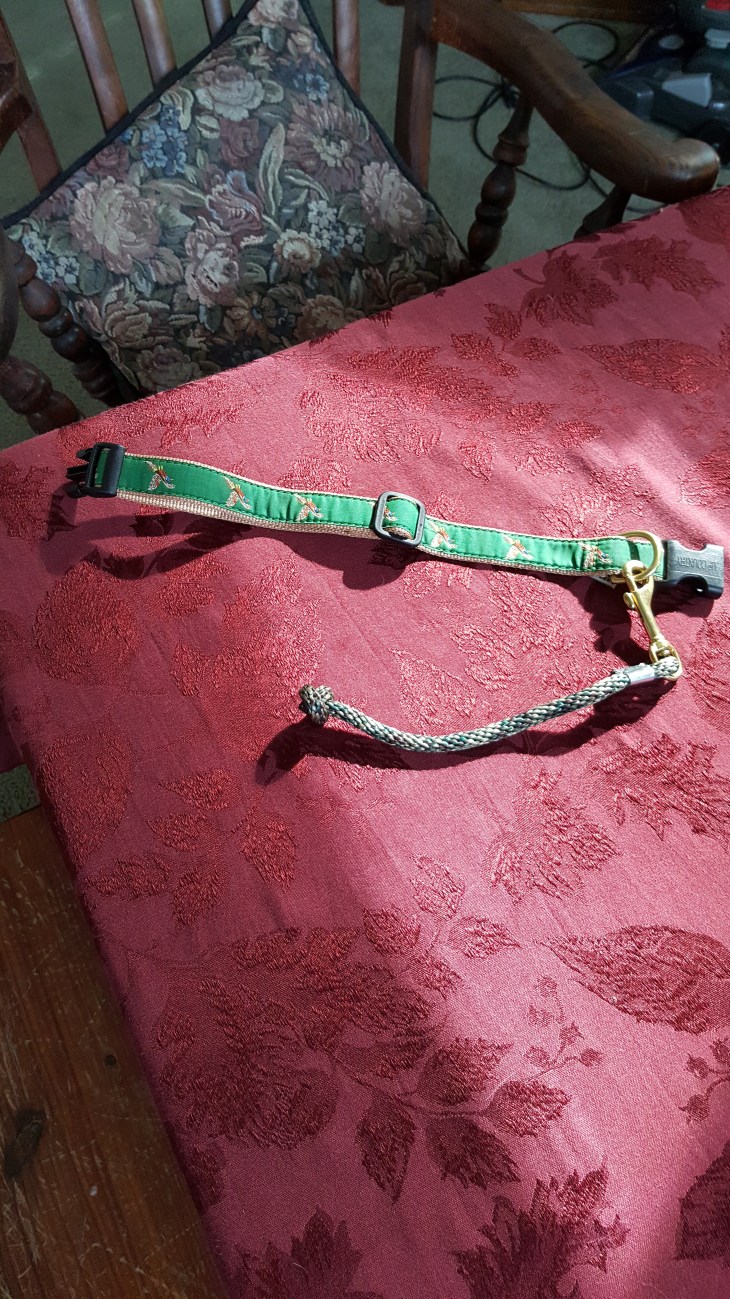
I’m not sure what kind of lead Mike uses, but my Goldens were trained steadiness with a short lead, called a tab, attached to their flat collars. That’s how I’ll train Lightning as well. I buy tabs online and tie a knot at the end to shorten them so they won’t catch in the dog’s feet. Here’s a picture of a tab attached to Lightning’s collar:

20160311_091125

Most of this post pertains primarily to the steadiness training we’ll be doing in Stage 2, but a tab is also used in Stage 1 for introducing the concept of steadiness.

It’s important that the dog not associate the fact that he/she is wearing a collar and tab with fact that he/she cannot break. Of course that’s elementary physics, but dogs don’t understand physics. As far as they can tell, some invisible force field is preventing them from breaking unless and until they are released.

It’s important that you retain that illusion, because if the dog comes to understand that the only time a break is impossible is when that collar is on, you’ve got what’s called a test-wise dog. That’s a dog who performs well in practice, eliminating the opportunity for corrective measures by the trainer, but then performs incorrectly in events when conditions are different, such as the fact that the dog is not wearing a collar, since collars are not permitted when dogs are under judgment in steady stakes. It’s a difficult problem to fix.

One way to help prevent the dog from being aware of the collar and tab is for the dog to wear the equipment in training even when you’re not working on steadiness. That doesn’t mean that the dog necessarily always wears those items, but only that he/she wears them often when no steadiness work is done. Dogs are superb discriminators, and this method takes away the dog’s opportunity to make the connection between the collar/tab, and the invisible force field as the dog experiences it.

A second way to prevent the dog from making that connection is to keep the tab’s length loose while retaining a tight grip on the end as the dog awaits throws from the gunner. If the dog remains steady, he/she is never aware the tab is there. If he/she attempts to break: you hold on tight; the tab instantly becomes taut before the dog can get further than a few inches; and the illusion of the invisible force field is born.

In Stage 2, I’ll work on Lightning’s steadiness so that no break ever occurs once I begin that training. Based on the experience of many other trainers as well as my own, eventually Lightning will become reasonably steady with that training. Perfection may actually not be achievable, at least for some dogs or perhaps without an unacceptable cost. In fact, they say there are only two kinds of dogs running in field trials: those who have broken, and those who will break.

As for Stage 1, I am not willing to risk detracting in any way from the process of Lightning discovering in himself an ever-deepening love of retrieving, which is my overarching goal for this phase of his life. And I believe a number of requirements for competition, such as deliver-to-hand and steadiness, take exactly that risk. So I’m mostly deferring those skills till Stage 2, by which time his love of retrieving will have fully blossomed.

But in our yard, I’ve begun to set up a few low stress retrieves that introduce lead steadiness. With Lightning wearing his collar and tab, I put Laddie and Lightning both into a sit and I throw a bumper, preventing Lightning from breaking by holding onto the tab. When he relaxes, I drop the tab and release him with “Lightning”.

As an aside, it’s common practice to send the dog on a mark using the dog’s name. If you call the working dog’s name, then the trained honoring dog, in this case Laddie, knows he is not being released.

Anyway, after Lightning returns with bumper, I again take his tab but try to hold it so he cannot feel that I’m holding it. With both dogs once more in a sit, I again throw the bumper, this time calling “Laddie”. If Lightning tries to break, I hold tight onto the tab and he is unable to move from his position. In this way, he is receiving an introduction to honoring after running a mark, as well as to lead steady.

I don’t intend to do much of this in Stage 1. But doing some of it at this point helps my PRT program conform to Mike’s renowned TRT program, and will hopefully pay off in Lightning’s overall development.

Update: In practice, I found that by the end of Stage 1, using the tab to prevent a break on gunner-thrown marks showed no risk of diminishing Lightning’s motivation. In fact, he quickly stopped trying to break on the gunshot, and sometimes didn’t try to break at all. Yet when sent on his name, he raced out with his usual enthusiasm, picked up the bird or bumper, and raced back. Accordingly, whoever is handling him at our practices these days always holds his tab while the marks are being thrown. I suspect he won’t need to be held, at least for bumpers, before long.

However, I rarely have the resources to set up an honor for Lightning, so we will defer that work to Stage 2.

Introducing land-water-land retrieves (with video)

For both of my Goldens, land-water-land (LWL) retrieves were a training challenge. The problem was getting back into the water carrying the bumper or duck after picking it up. Lumi had difficulty at first, but learned to do it fairly quickly. Laddie could do it when he was a puppy, but about the time he turned a year old, he stopped being able to do it and it took me months to figure out how to solve the problem.

Now it was Lightning’s turn. Since he was pretty comfortable with open water retrieves during his first two swimming sessions, for his third session today I thought I’d see how he’d do with some LWL retrieves.

First I packed a long line into the van. If it turned out Lightning was unable to come back across a channel, I’d be able to attach the line to his harness and gently draw him back into the water. That’s the approach that finally worked with Laddie so many years ago, and remarkably, he never needed help with it again after the first time I did it.

Then I picked up two assistants, Peter and Annette, after their classes and work were over, and drove them with the dogs to the training property closest to where I live. Unfortunately, with rush hour, it was a two hour drive, leaving us less than an hour of sunlight to train. That would only leave time for one session for each dog.

First I ran Laddie on a water double and a big water blind, the three retrieves all involving several water re-entries and other challenges. Though it was Laddie’s first water series since last fall, he did a nice job.

For Lightning’s turn, I asked Peter to throw for us and gave my phone to Annette, who I’ve found to be a gifted videographer, so she could take videos of Lightning’s work.

As with Lightning’s previous two water sessions, I didn’t put on his harness and check cord. I didn’t think he’d attempt to play keep-away, and I didn’t want to get the equipment wet unnecessarily.

I started with a straightforward training plan and was prepared to make adjustments as needed once I saw what difficulties Lightning would have. But I didn’t need to make any adjustments. Lightning accomplished each step with little difficulty. Although the plan was pretty obvious, I’ll describe it in case it’s helpful for anyone.

First I chose a water crossing about 20y across, with a low shore on the far side and no obvious way to run around the water. Peter stood on the far shore and threw bumpers when I called for them, firing a blank pistol with each throw. I ran Lightning from a mat 10y from the water on our side, as usual only requiring him to sit in order for me to call for the throw. He would launch excitedly on each gunshot, then adjust the direction he was running once he saw where the bumper was being thrown. We’re not working on steadiness yet.

The first throw required him to swim about two thirds of the way across the channel for an open water retrieve. He ran to the water, but having only swum in one location before, he needed some time to run up and down the shore a bit before getting in this new water. Once he waded in, he seemed to have lost track of the bumper, so I had Peter fire the pistol and throw another one, a bit closer to us this time. Lightning grabbed that one and brought it back to me.

I then asked Peter to pick up a rock and throw it to the bumper still in the water to attract Lightning’s attention. But before Peter had a rock ready to throw, Lightning darted into the water on his own and headed for the bumper. I told Peter not to throw the rock after all, and Lightning brought me the bumper a moment later.

The third throw was right at the shoreline, and the fourth was a foot or so inland. Lightning had no difficulty with those. Finally I had Peter throw his fifth bumper to the base of a tree standing further back from the water, about 10y.

Lightning ran, swam, and ran straight to the bumper, picked it up, and raced back toward me, but when he got back to the water he stopped. I whistled come-in and called Here. He ran up and down the shore a couple of times, then finally waded into the water and swam back. We ran one more retrieve in that location and Lightning got back in the water on the way back without hesitation.

We still had some sunlight so I decided to increase the challenge a bit more with a new location. This time:

  • The land entry, from the mat to the water, was longer and the embankment down to the water was steeper.
  • The embankment on the far side was quite steep.
  • The throw would be over the far embankment, so once it landed, it would be out of sight until Lightning got close to it.

Here’s Annette’s video of how Lightning did:

Second day swimming (video)

With air temp of 77 degrees and climbing, I took Laddie and Lightning out for our second day of swimming this year, Lightning’s second day ever.

Here they are going out for water retrieves. I’m afraid that’s as far as I can throw these days. Lightning, who had a head start, is on the left.

They each ran about a dozen retrieves. I was able to take Lightning’s bumper before he dropped it to shake off most times, so that was also good practice for him.

Lightning at six months

If you’re using Lightning’s journal as a guide for training your own dog, you are probably aware that we are still in the first stage.

I‘ve characterized this elsewhere as the pre-teething stage, but I think calling it Stage 1 is a better designation. That is, if I were training an older dog already past teething, I’d still start with the same training.

In Lightning’s case, all his adult teeth are in, but circumstances have prevented me from giving Lightning as strong a foundation in some of this work as a dog being trained by a professional with a staff, a training property, and a location in good weather for swimming — in other words, one kind of dog I expect Lightning to someday be competing against. So rather than rush into Stage 2, I’m continuing to strengthen Lightning’s foundation with some of our Stage 1 items. 

The Stage 1 list for my Positive Retriever Training (PRT) program is made up of the 18 items on Mike Lardy’s “Socialization and Introduction to Field” at the top of his TRT Flow Chart (you can view it with an online search), plus some additional items of my own. Here then is a rundown of the PRT Stage 1 items and how Lightning is doing with each one. If you’re following this program, hopefully your list looks similar.  

First, Mike’s items:

  1. Introduction to Crate. Lightning has completed this item. I serve his meals in a crate indoors, he sometimes goes in there to nap on his own, and he rides in a crate in the van.
  2. House Breaking. Lightning has never pooped indoors since I’ve had him. In addition, he nearly always pees outside, but he still makes mistakes indoors. One kind of mistake is when he gets excited with a new visitor petting him. My holistic vet says this is involuntary and will probably pass as he gets older and more confident with strangers. The other kind tends to happen after a rough-housing session with Ryley, DW Renée’s 8mo Golden. It’s easy to prevent. I just need to get Lightning outside immediately after they’ve been playing, but sometimes I’m too slow. This is a training issue and will hopefully be completed someday.
  3. Playing with Kids and Adults. Lightning’s been around kids, adults, and other dogs. He’s crazy about all of them. I don’t see this item as needing additional work other than in the normal course of events.
  4. Traveling in a Vehicle. Lightning rides in a crate in the van, sometimes for hours at a time. He readily leaps in and out of the crate on cue. My verbal cue is “hippity-hop” rather than the more usual “kennel”.  My visual cue is a sweeping hand gesture. When we ride in Mommy’s car, Lightning and I sit in the backseat with one of the other dogs without difficulty. So I consider this item completed.
  5. Learning Limits. Lightning has several examples of this. For one, I can call him away from a play session with Ryley and he’ll curl up at my feet (that is, on my feet) or on the couch and ignore Ryley’s attempts to re-engage him unless I release him with a verbal “OK”.
  6. Nature Walks. Lightning and Laddie play in the woods behind our house many times a week. My back injury, and later the winter weather, prevented me from hiking until recently, but now we’re getting out frequently.
  7. Simple Obedience with Treats. For a field dog, I think the primary obedience skills are Here, Sit, and Heel. I originally clicker-trained all of them using treats, and Lightning has considerable experience with them, but they’ll always need more practice.
  8. Casting Games with Treats. I’ve never quite understood what Mike means by this, so unless it happens to coincide with other work we’ve done with body language such as sweeping hand gestures, this may be an omission in our Stage 1 work. Hopefully it’s not a serious hole in Lightning’s training.
  9. Walking on Leash (2 sides). This is a work in progress. By the way, I always try to balance all our training on both sides.
  10. Introduction to Retrieving. This has always been my major focus, and Lightning has had scores of training sessions running marks.
  11. Introduction to Birds. I often bring thawed birds for Lightning to retrieve, and he recently had his first flyer at a club training day.
  12. Introduction to Water Retrieves. We finally got this item covered yesterday, as described in my previous post.
  13. Introduction to Gunner-thrown Marks. Lightning has had this work in several guises. Whenever possible, I bring one or more assistants to our training sessions and they throw marks using blank pistols as gunfire. When I can’t get even one assistant, I use poorman singles, again with a pistol, or, if that’s not possible in a particular location, hey-hey-hey. In addition, of course, Lightning ran three gunner-thrown marks at the club training day last weekend.
  14. Introduction to Gunfire (at a distance). Lightning has months of experience with blank pistols, and additional experience with shotgun fire this last weekend.
  15. Introduction to Upland Hunting. I’m not a hunter, so this will be an omission in Lightning’s training.
  16. Introduction to Lead Steady. I’m not clear what Mike has in mind for this item, but I place a premium at this stage on developing Lightning’s motivation, so I may be de-emphasizing steadiness more than Mike does at this stage with his dogs. Or maybe not. In any case, Lightning has always run outdoor retrieves wearing a check cord used to hold him till the handler releases him, and we generally don’t call for a throw until Lightning sits on cue (I use a whistle Sit these days). In addition, Lightning is required to wait until I return to his side and send him on poorman marks. So hopefully we’re covering this item enough for the present stage of training.
  17. Walking Singles. This is the primary way we practice retrieving when I have a single assistant.
  18. Yard Multiples. I’ve worked with Lightning on doubles in the house, in our yard, and in other fields, but after several sessions a few weeks, I’ve mostly discontinued this. As I discussed in a recent post, I’m more concerned at this stage with Lightning learning to lock in and give his full attention to every throw, rather than possibly impairing that training by having him practice multiples. He did have an introduction to the concept, and he’ll still get a few more as we continue Stage 1. Of course in later stages of his development, he’ll get a great many more multiples in many configurations over the years.

That completes our survey of Mike’s items. Now some additional Stage 1 items of my own:

  • Selecting the puppy. This of course precedes any training. I discussed it in one of my first posts for this journal.
  • Vet appointments. This is for exams and vaccinations. I rely primarily on a well-known holistic vet in our region, who I’ve been taking my dogs to for more than a decade. For emergencies, we’ll use a local conventional veterinary practice we like, and we have a number of specialists we’ve found over the years we can go to when needed.
  • Handling paws, ears, etc. Lightning was always comfortable with most handling, but he didn’t like his paws and toes handled at first. Other dogs might have other sensitivities. The earlier the puppy has an opportunity to become comfortable with all kinds of handling, the easier it will be for you, vets, and others to care for him.
  • Nail trimming. As I mentioned in a recent post, I waited till Lightning was six months old to get him comfortable with having his nails trimmed with a Dremel. It only took about a dozen sessions spread over a single day. I suspect it could and should be done earlier if possible.
  • Socializing: puppies, adult dogs, other pet species, horses, children, other races, men, women, hats, umbrellas, back packs, trash cans, etc. I’ve broadened the socialization items from Mike’s list, and I look for every opportunity to give Lightning new, enriching experiences.
  • Tug. I used to play a lot of tug with Lumi and Laddie, knowing that it’s a major tool for building motivation for some sports such as agility and Schutzhundt. I have taught the game to Lightning, and he sometimes plays it with me and with other dogs. However, I’m not convinced that Lightning considers it a major reinforcer as the Goldens did, and therefore I’m not sure it matters much for building motivation for the retrieve in Lightning’s case. This may vary with different breeds as well as with the individual. 
  • Catch. A few weeks ago I taught Lightning to catch a tennis ball in the air. This is a game he seems to love, often initiating it on his own. As mentioned in an earlier post, I consider it a valuable game for a retriever for a number of reasons. I intend for Lightning also to learn to catch thrown treats, but we haven’t worked on that much and I don’t consider it as useful as playing catch with a ball, since treats don’t have the delivery-to-hand component.
  • Leave it. This is a secondary but invaluable obedience cue, as discussed in an earlier post. As with other obedience work, it’s a skill to train early in the dog’s life and continue practicing for a lifetime.
  • Stay on mat. This is a special case of Mike’s “Learning Limits” item. I’ve trained my other dogs to stay on a mat away from me for long durations, and I think it’s an invaluable skill. But I think Lightning had gotten the same training benefit from the kind of thing I described under “Learning Limits” above. He seems to have a natural stay.
  • No jumping up unless invited. This is a work in progress.
  • No counter surfing. Another work in progress. Lightning rarely counter surfs, but he has destroyed a few items he should have left alone.
  • Charge clicker. As I’ve described previously, I like to recharge the clicker frequently when we use it. But I’m finding fewer uses for a clicker at this point in Lightning’s training.
  • Hand touch. This is the first cue I like to train with a clicker, but I also like to continue practicing it, since it strengthens the dog’s response to sweeping hand gestures. I still practice it with Lightning sometimes.
  • Wearing the dog. The value of tethering cannot be overstated. It can be an enormously valuable tool for several behavioral issues, and I think all my dogs are more responsive to me because of it. However, Lightning is extremely thin-boned and I’m afraid he’s more fragile than the Goldens around his neck. Since he seems to have become a Velcro dog anyway, I rarely tether him indoors.
  • Visual Sit, verbal Sit, remote Sit, whistle Sit. This item is another special case of one of Mike’s items. I consider these to all be skills taught and practiced during Stage 1 and have done so with Lightning.
  • Two-sided heel with automatic sit. This is another special case of one of Mike’s items. As I’ve described in previous posts, I’ve trained and continue to practice this with Lightning in several variations, such as walking at heel, coming to heel from a front approach, and swinging from heel on one side to the other.
  • Practicing retrieves from a mat. I often bring a rubber mat to the start line when practicing retrieves with Lightning as well as Laddie. Like a novelist or screenwriter using a knife or other object to focus the reader’s attention, I believe a mat helps a retriever conceptualize both the beginning and end of the retrieve pattern. 

I think that covers most if not all of the training items in PRT Stage 1, where Lightning, who just turned six months old, is continuing his daily training.

Waterdogs

Although it’s still winter and we’ve had some cold weather the last few weeks, yesterday had a high in the 60s and today reached the low 70s.

While I knew the water would still be cold, I thought today would still be a good opportunity to introduce Lightning to water deep enough for swimming. 

The process was straightforward and went well. I brought Laddie and Lightning out to a beach that we would have to ourselves and took off Lightning’s harness. I had brought two 2″ white bumpers. I threw one as far as I could without risking an injury to my back and sent Laddie. While he was swimming out, I tossed the other bumper into shallow water. Lightning immediately knew it was for him. 

Over a period of a few minutes, he worked up his courage to wade into the water and fetch the bumper. During this time, I didn’t prompt him or interact with him at all. When Laddie would return with his bumper, I’d throw it back out for him. I’m guessing seeing Laddie swimming may have normalized the idea of it for Lightning, but I can’t be sure. 

When Lightning finally retrieved the bumper from the shallow water, he ran around with it on shore for a little while and then dropped it. I immediately picked it up and threw it back out, just a little further. He brought it back sooner the second time and I continued to stretch the distance.

Around the seventh throw, the water was too deep for Lightning to retrieve without swimming. He launched himself, swam for the first time in his life, grabbed the bumper, swam back with it, and dropped it for me to throw again. 

I continued throwing bumpers for both dogs, throwing Lightning’s further each time till I was throwing it as far as I could, the same as Laddie’s. Lightning was confident swimming on every retrieve, though he still used a splashing puppy stroke and hasn’t yet learned to keep his paws under water.  

When the sun set, I brought them back to the van and towel dried them. I used our air blower on them when we got home, another new experience for the little one.

Tomorrow is supposed to be warmer than today. Along with other training, I’ll take them swimming again as early as I can arrange it. 

Trimming nails

Because I was never able to condition Lumi to having her nails trimmed without stress even after many attempts, I began having Carol, our holistic vet, take care of Lumi’s nails, and then Laddie’s as well when I got him about eight years ago.

When I got Lightning four months ago, I assumed I’d have Carol do his nails as well. But last month it was a huge struggle, and when we came for our latest appointment last weekend, he was uncomfortable around her. She did Laddie’s nails but not Lightning’s, and at the end she said, “You’re going to need to do Lightning’s nails, Lindsay. I won’t be able to take care of him if he’s afraid of me.” I could see that. Vaccinations, blood draws, chiropractic adjustments, and so forth would all be too difficult.

I’m pretty sure I could have started conditioning Lightning to let his nails be trimmed when he was younger using the same approach I’ll describe here, but at least I can say that this approach worked well for Lightning at the age of six months. Now he relaxes while I do his nails.

An online search will show you several articles and videos on how to use a Dremel to trim your dog’s nails. I read a couple of them and found them helpful. They describe what angles to use and how to get close to the quick but not too close. They even suggest a final coating of petroleum jelly or olive oil.

For equipment, I use a variable-speed, cordless Dremel with 120-grit bands, and I use it at or near the slowest speed, 5000 RPM. 

Here were the steps I used to condition Lightning to having his nails trimmed, a series of short sessions over a period of a couple of days:

  1. I’m right-handed, so I got Lightning comfortable lying quietly on his left side on the couch with all four feet accessible as I knelt on the floor beside him. He didn’t have to get into that position himself. Rather, I wrapped him up in my arms and lay him down. As he lay there, I gave him small dabs of PB from the end of my finger along with kisses, and I spoke softly and gently to him. At first, every time I released my hold, he tried to get up and I tightened my arms again to keep him restrained. His efforts diminished and finally I could release tension without him trying to get out of position. Once he was relaxed, I wrapped my hand for a moment around each of his feet, going from one to another in random order repeatedly, again offering dabs of PB, and again gently restraining him when he attempted to get up, till he remained still on his own. By the third session, when he readily relaxed, I began to separate his toes and touch his nails with my finger, accompanied by occasional tastes of PB At the end of each session, I released him with “OK” and he leapt off the couch.
  2. After a few such sessions, the next step was similar, except that I took each of Lightning’s paws and then touched the top of his nails with the Dremel turned off. Lightning readily allowed me to do this to his back paws. However, perhaps because of his experience with Carol and her grinder, he was adamantly opposed to the Dremel touching his front paws while lying on his side. Luckily, I found he was surprisingly relaxed about it when I put him on my lap with one arm wrapped around him to hold his front paws and hold the Dremel in my other hand. From then on, I found that a number of positions worked equally well.
  3. In the next step, I continued as before but now with the Dremel turned on, humming and vibrating, always at the lowest speed. At this stage, I touched him with the grinder’s handle and did not let the grinder wheel touch him.
  4. At last, starting with just a split second on each nail, I began to apply the grinder wheel lightly to his nails as I held each nail in position.
  5. I gradually reached my final version of nail trimming, where I still use no pressure and still don’t stay on any nail more than a second. I still give occasional dabs of PB during the process, though I may stop that eventually. I apply olive oil to the nails after trimming them. I plan to trim them about once a week. 

By the way, as long as I was going thru this process with Lightning, I went thru it with Laddie, too. I suppose he didn’t have the negative associations that Lightning had, because he was more relaxed from the beginning. I guess I’ll be able to take care of trimming nails for both of them from now on.

Update: See the follow-up post, Daily nail trimming (with video).

Returning thru cover

For a dog at Lightning’s stage, already with good experience returning well on marking retrieves, a particular challenge that needs to be addressed explicitly is returning thru obstacles such as cover, especially with a bird. This is a different picture from returning when the handler is in clear sight at the start line, and both of my Goldens tended to break down on their returns when we first began to train on such lines years ago.

So today, while driving around looking for a good place to throw a few poorman marks for Lightning, I spotted this area off the side of a dirt road in a nearby park :

20160304_160706

These were not long retrieves, but there were lots of landing spots I could throw the bird to where Lightning would have an obscured path back to me once he picked up the bird.

Not surpassingly, his first few returns were unsatisfactory. He would pick up the bird and then ignore my come-in whistle, instead playing with the bird or carrying it sideways or further away. On those retrieves, I had to go to him. If necessary I would have used his check cord to draw him back to the start line, but it didn’t happen to be necessary. Once I was close to him, he was willing to chase me back carrying the bird.

I don’t know whether further reinforcement than just the chance for another retrieve was necessary, but I had some sliced ham with me and used that to reinforce a whistle Sit once we were back at the start line. Not only did that create a strong positive association with the return, but Lightning also readily gave up the bird to get the treat.

After several retrieves that showed gradual improvement, Lightning finally began picking up the bird and coming straight back. A few more sessions in areas with high grass, both in clumps and strips, and other obstacles such as logs, mounds, and ditches, will hopefully strengthen Lightning’s returns even more.