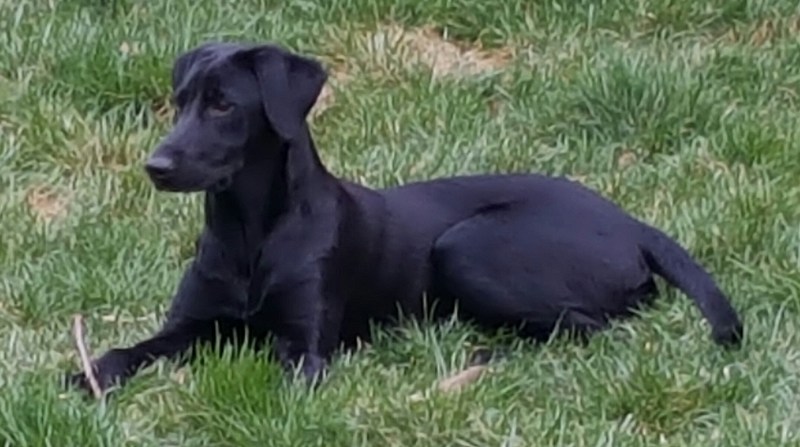
Lightning at a year old

Lightning is now a year old. He’s still 44lbs, and still  a joy. But a few weeks ago his training stalled in the early work of PRT Stage 3, corresponding to TRT Transition. We were in the middle of blind drills and diversion drills, where he was making good progress on those concepts, when his recall and returns abruptly began to fall apart. It may have been because I was using dokkens for the marks, I’m not sure. But it soon got to the point where he couldn’t come straight back even with a 2″ bumper.

I had no choice but to turn our focus to his returns. We trained nearly every day, though hampered by a typical assortment of factors: record warm temperatures, crippling pain in my ankles and knees, and limited availability of my assistants, who are now in college rather than high school. But we got a lot of work done and made gradual progress.

It’s a difficult topic to write about from an instructional view, because I don’t know whether your dog will even have this issue, and I’m pretty sure there’s no cookie-cutter solution that works on all dogs that do develop the problem, unless you want to depart PRT and begin using an ecollar. I think the one common solution is not to get frustrated and not to give up. Understand that this is probably the most difficult skill you’ll ever have to teach your dog, it’s hard, and it’s going to take time and patience.

That said, here are some of the things I’ve done that I believe proved helpful in Lightning’s return training:

  • Endless games of fetch, indoors, yard, and fields, with every available article. I occasionally ask for steadiness, but usually not. Lightning can play this game for dozens of fetches. It seems almost impossible for him to get tired of it.
  • Short walking singles with an assistant, with Lightning on a long line. I use lines of 15′, 30′, and 60′. Sometimes I throw, sometimes my assistant throws. We use a wide variety of articles, from 2″ bumpers with ropes, to 3″ bumpers with ropes and streamers, to duck and pheasant dokkens. If Lightning doesn’t bring the article back, the handler gently reels him in. He usually tries to grab the article to bring with him but it doesn’t matter whether he’s successful in that or not  He learns a useful lesson either way.
  • For reinforcement, I’ve used the heel and catch game, gunshots, and food. Overall I felt we made best progress with food, though you don’t have to use secondary reinforcement (the food) on every retrieve because the work itself still provides the primary reinforcement. If that’s not the case with your dog by this time, you’re probably not going to get much further IMO. But Lightning still makes noticeable improvement on his returns when I reinforce with food, and I feel it would be stupid for me to be too stubborn to realize that and refuse to leverage it.
  • Occasional marks without a long line mixed in during the walking singles. Finally, finally, a day comes when you can do a whole session with no long line, and just gradually build up some distance.

A few other nuances are involved, such as choice of terrain and so forth, but it’s really kind of boring to talk about. It’s just a lot of work and a lot of faith that it will eventually pay off. And indeed, finally it has done so with Lightning and we are nearly ready to resume our PRT Stage 3 training. I expect relapses, which we’ll address the same way. I may not always discuss them further in this journal.

How hard is it to win a field trial?

A couple of old internet acquaintances were kind enough to tag me in a Facebook thread and invited me to say something about the challenges of winning a retriever field trial. I thought I’d pass the posts along here:

Patrice Dodd: You should see if you can find Lindsay Ridgeway’s blogs. He has trained Golden Retrievers to Master Hunter level and has won JAMs in field trials, in the USA. All positive trained. He has adapted Mike Lardy’s program with significant modifications.

Greta Kaplan: I have known Lindsay for ten years or so. So far he’s not winning field trials and that is the key point here. He is aware of this discussion, I promise.

Me: I trained Lumi to JH, SH, WC, and WCX. She was a fabulous marker and often lined blinds. She took First in the first competition she ever ran in. I trained Laddie to JH, SH, MH, and WCX. He took First in both of the first two competitions he ever ran in. He received a JAM in his very first field trial, when he was still three years old. He’s since earned many more JAMs and Reserve JAMs, and took Third in a trial with 33 dogs last fall, mostly professionally trained and many being handled by pros as well. He is a superb marker. Many friends with more accomplished pro-trained dogs have told me they consider Laddie more talented. But by all means, let’s focus on what my dogs haven’t achieved yet.

Greta: Sorry, Lindsay Ridgeway. That was not my intent. I tagged you in the other thread because I knew you were out there doing it. I have to admit here that I have no understanding of the titling structure for field trials so it’s hard for me to know how truly competitive those things are. Are there levels of competition? What are the top awards?

Seriously, no slight was intended.

Me: Thanks so much for tagging me. Very interesting to me. Yes, four main kinds of FT stakes: Derby: for dogs under 2yo, no handling allowed, specialized, difficult marking tests, not interesting to me Qualifying, also called qual/Q/minor: open if dog has not won two of them, same skills as all-age, usually a bit easier on average, some all-age options never occur in Q. Tasks: land and water multiples, usually triples, plus land and water blinds. All-age, separated into two stakes, Amateur (am) and Open. Same dogs, but handler cannot be a pro trainer in the am. Most dogs in all stakes are trained by pros. Placements in all stakes are dominated: pros (except am stake), field trial property owners, multi-dog amateurs who travel south for winter training, north for summer training. Despite quality breeding and pro-training, many dogs never finish a trial or earn a JAM.

I would say greatest challenge to finishing a stake is difficulty of stake itself, though I think some politics involved. Greatest factors to one of four placements, especially First and Second (which in Q earns unofficial designation Qualified All Age QAA): handler often has hundreds, possibly thousands of stakes under belt; handler often running multiple dogs, essentially do-overs; unfair situations for some dogs, such as change of wind or unintended help by gunner, but part of the game, evens out over time; few would deny politics sometimes involved, that is, personal relationships. Deciding factors in this order, I think: experience of handler, breeding of dog, training of dog, running order; even luck sometimes important. Not sure whether breeding or training more important, both crucial, but both less important than handling skill/experience in general.

So with respect to a positive trainer winning, so many issues besides whether you use aversives, such as: do you have: Group A: time to train hours every day for years on end, tolerance for intense physical and emotional demands, pretty serious money including high quality trial-bred dog. Group B: opportunity to travel south for winter, north for summer, opportunity to run multiple dogs in a stake, good social skills, other mysterious factors I haven’t discovered yet. Groups A and B both crucial. Laddie and I only have Group A. Many people have told me what Laddie has accomplished is amazing.

So yes, it’s somewhat harder and more time-consuming to train without aversives. No videos or programs available for positive advanced competition training except the PRT program I’m developing in Lightning’s Journal. But too many other crucial factors to prove that a dog trained that way can’t win. Most dogs can’t win even with traditional training.

Virtually all pros and experienced trainers believe it would be impossible for positive-trained dog to win, which cannot be discounted; they should know. But they also don’t believe a positive- trained dog can earn an SH, MH, Q JAM, Q Reserved JAM, or Q Third, and Laddie has done all of those, so puts their ability to predict in question. I’ve probably run out of time with Laddie. He’s almost 10yo and I have health problems that limit our training right now. But I think Lightning will finally get that win some day if Laddie doesn’t beat him to it.

Oh, I forgot to mention huge importance of access to quality field trial grounds for practice several times a week plus training group with experienced, successful trainers willing to share knowledge. I use paid assistants, generally high school kids. We usually train at construction sites or parks till we get kicked off. Slight difference from pros with multiple high-quality properties in North and South for year-round training, plus experienced training assistants and large community of peers who have used virtually identical training programs for success with many dogs. As far as I know, no one else in America is doing what I’m doing. Maybe some will and Lightning’s Journal would save them a lot of missteps, but it’s a long road.

Greta:  THANK YOU for filling that in.

Blind drills, taught blinds, and diversion drills

With some breaks for Laddie’s competition and because of the record-breaking heat, I’ve continued working with Lightning on the Stage 3 drills that Mike Lardy, in the TRT program Transition stage, calls blind drills, taught blinds, and diversion drills.

Several goals are involved in this work for Lightning, both those that Mike sets and others more appropriate to Lightning as an individual. Here are the challenges we’ve been tackling:

Locking in on the blind when a gun is in the field

In our early blind drill sessions, Lightning would focus on Liza, my assistant, as long as she was in the field, and I couldn’t get him to lock in on the blind.

To address that, we used this sequence:

  1. Lightning runs blind with empty field.
  2. Liza comes out, throws, sits down, and Lightning runs mark. As Lightning returns with article, Liza packs up chair and walks off field. Meanwhile, Lightning runs blind. 
  3. Normal: Liza throws and Lightning runs mark. Then Lightning runs blind.

Soon Lightning understood the concept of running a blind while a gun was in the field and the problem was resolved.

Not flaring when running a blind behind the gun

Once Lightning was doing a good job with marks being thrown toward the line to the blind, we continued with the diversion drill and marks being thrown away from the line to the blind, so that Lightning was running behind the gun to run the blind. Like other dogs. Lightning tended at first to flare off the gun as he went past, running a curved line.

We readily solved the problem of Lightning flaring left by training with the following sequence:

  1. Run the blind from a position level with the gunner.
  2. Run the blind from a few yards further from the blind, so that Lightning would take a few steps before getting past the gunner.
  3. Run additional blinds from further and further back, adding a few more steps each time before Lightning would run past the blind.

Getting Lightning to stop flaring around the gun when it was on the left of the line to the blind proved more difficult, perhaps because Lightning has a slight predisposition to flare right even without running past a gun. To resolve the problem, I placed a chair on the field 20y from the gunner in the direction of the blind, on the opposite side of the line from where the gunner sat. Both chairs had their backs to the line to the blind. The second chair blocked Lightning’s curving path and he ran a straight line. We continued to use the second chair for several sessions and then found it was no longer needed.

Returns with complex articles

In order to better prepare Lightning for participation in training days, I decided it was time to stop using only 2″ bumpers with no ropes. Instead, we switched to orange 2″ bumpers with ropes for the blinds, and dokkens for the marks. We used a random mixture of mallard and pheasant dokkens.

Unfortunately, Lightning’s recall fell apart, especially with the dokkens. I tried a number things without success: bringing him out to the field on a lead instead of letting him run around, as I normally do; increasing my persistence in calling him both verbally and with a whistle, including walking to him; and conversely, calling him only once and then just waiting. None of those seemed to have any training benefit.

I also tried bringing high value treats to reinforce his returns. That seemed to help for a few sessions but then wore off. He still wanted the treats, but not enough to stop playing with the articles and just come straight back.

Finally I put on his harness and attached a 60′ line. I had Liza throw the marks so that they landed within 60′ of our start line, allowing me to draw Lightning in once he reached the dokken. I then left the line attached while sending him on the blind, though it was much further away and I couldn’t continue to hold the other ended of the line. Luckily, just wearing the line was enough to influence him to return promptly.

So now we’ll continue with those strategies for a time, and hopefully soon I’ll be able to run Lightning without the line and still get nice returns of dokkens, and bumpers with ropes and streamers. For now I think it’s the right strategy. It’ll just take some time.

Blind drills

I worked on pattern drills with Lightning for three days. The first day, I ran him on shortened versions of the left leg a few times, then the entire 100y left leg. The second day, I started by running him on the left leg, then ran him on the right leg, again 100y and at a 90° angle to the left leg. The third day, I ran him on the left and right legs, then the middle leg, again 100y and between the left and right legs. The second and third days, I neither indicated the piles with throws not ran shortened versions.

Lightning had no difficulty with any of the pattern drill retrieves, so it was time to move on to what Mike Lardy calls “blind drills” in his TRT program. Our PRT program goes to the same set of training objectives, except that we continue to use no physical aversives for force or corrections. 

For Lightning’s first day of blind drills, I used the same course we had used for pattern drills, but we didn’t use the middle leg. Here were the steps we followed:

  1. With gun sitting in chair to left of left leg, run left blind.
  2. With gun standing in front of chair, run left blind.
  3. Gun stands, calls hey-hey-hey, throws dokken toward left leg, and sits down. Lightning picks up mark.
  4. Run left blind. When Lightning veers off line toward old fall, blow sit whistle, then cast to blind.
  5. With gun sitting in chair to left of right leg, run right blind.
  6. With gun standing in front of chair, run right blind.
  7. Gun stands, fires pistol, throws dokken toward right leg, and sits down. Lightning picks up mark.
  8. Run right blind. When Lightning veers off line toward old fall, blow sit whistle, then cast to blind.

Additional details:

  • All blinds were orange 2″ bumpers with ropes.
  • I used a high value treat to reinforce returns.
  • I randomly alternated which side I ran Lightning from on each retrieve.
  • The blind piles were marked with orange lining poles.
  • I forgot to use Lightning’s tab, and he broke on step 3. I walked out, took the dokken and gave it back to gun, walked Lightning on lead back to start line, and made a make-shift check cord out of his slip lead. We then reran the mark. Lightning did not attempt to break, and when I sent him, I let go of one end of the check cord so that it slipped off his neck as he launched. I didn’t use it again, and Lightning didn’t break again.

We’ll continue work on more complex versions of the blind drill tomorrow.


Pattern blinds

To begin Lightning’s PRT Stage 3 training, we’re following the discussion of pattern blinds in Mike Lardy’s TRT program. Beyond that discussion, there’s not much to add.

Today, I selected the field we’ll use for pattern blinds and placed lining poles at the start line and the 100y left leg of the course, then placed 2″ white and orange bumpers, all with ropes, in a pile at the end of the left leg. I ran Lightning to the pile once from a shortened line, then backed up to the start line to run another half dozen retrieves the full 100y.

Tomorrow, we’ll add the right leg of the course, and the following day, if Lightning’s ready, we’ll add the center leg. Then Lightning will be able to work on the complete pattern blind drill.

Lightning begins PRT Stage 3

Within the PRT program, Lightning has now completed all of the Stage 2 yard progression on land and all of the Stage 2 field progression on both land and water. In fact, the only Stage 2 work he has not completed is the last two steps of the last Stage 2 yard drill, the swim-by. We’ve begun the swim-by and will continue as opportunities to train on water permit.

But in the meantime, it’s time for Lightning to begin Stage 3 of the PRT program. Just as PRT Stage 2 corresponds to Basics in  Mike Lardy’s TRT  program, PRT Stage 3 corresponds to TRT Transition. We’ll continue to base the PRT program on TRT, just eliminating the use of physical aversives, which traditional trainers use for corrections and force, from the PRT approach to developing the same skills in the same sequence. 

As the TRT video explains, however, sequence is more flexible in this new stage of training, and will vary with circumstances such as availability of training properties and the dog’s own pace of development. Here in Lightning’s journal, I’ll record the particular sequence I follow with Lightning, with the understanding that other PRT trainers will choose their own sequence to cover the same material. For example, you may have completed training the swim-by from Stage 2. Lightning and I still need to wrap that up.

Mike mentions in the video that this is an exciting stage of training because the dog is learning new things every day. The narrator also mentions another exciting point: in a few months the dog will be ready to run in qualifying. For Lightning, that means he may be able to begin competition as early as spring or fall of 2017. Wow!

Double T step 8: disciplined casting

As Mike Lardy explains on the TRT video, the last step of the double T progression is disciplined casting, which is the field trainer’s term for stopping the dog during his/her return and giving a cast while he/she is already carrying a bird or bumper. 

Yesterday Lightning had a good session of step 7, the double T itself, with the side piles at 30y, and today he was doing well with the side piles at 25y, so I tried blowing a sit whistle on one of his returns, then casting him with an Over to one of the side piles even though he already had a bumper in his mouth. He took the cast instantly. Later on, he took another disciplined Over cast with equal ease.

The only problem he had with disciplined casting was with a Back cast. That confused him. But we’ll work on it some more over the next few sessions as we continue to wrap up our Stage 2 yard work, with sessions at the swim-by pond as often as possible. When swim-by is done, we’ll begin Lightning’s Stage 3 training.

Swim-by step 1: teach the pile

Mike Lardy provides instructions for the swim-by drill on the third disc of the TRT video. The swim-by is the last step of the yard progression in the Basics segment of TRT, and is also the last step of the yard progression in Stage 2 of the PRT program we’re building. Since we have already worked on every element of the Stage 2 field progression, the swim-by is also the last step of PRT Stage 2 overall. When we finish swim-by, we’ll begin Stage 3, which corresponds to TRT Transition.

You might have noticed that we’re beginning swim-by step 1 even though we haven’t completed double T steps 7 and 8. That’s consistent with Mike’s comments on the TRT video, and works well for us because I was able to arrange training with a swim-by pond at this time. But I’m not planning to cut Lightning’s work on the double T short. We’ll continue working on that in our early morning sessions until Lightning is fluent in double T steps 7 and 8, even as we work on swim-by step 1 when we get the opportunity.

Step 1 of PRT swim-by has the combined objectives of the first two steps of TRT swim-by, that is, teaching the line to the pile and force to pile. Of course PRT doesn’t use a physical aversive, that is, an ecollar, to increase the dog’s drive to the pile. But just as we found with pile work and the double T on land, a positive-trained dog will drive hard to the pile even though no force is used. I saw that years ago with Lumi and Laddie in this stage of their training, and it’s been equally clear with Lightning. I expect to see that same drive in the swim-by as well, beginning with strep 1.

Double T step 7: double T (with video)

After the adjustments that enabled Lightning to be successful with step 6 of the double T, the full T, the next morning we began work on step 7, the actual double T. As Mike Lardy illustrates in the TRT video, the double T course uses two horizontal lines with bumpers at the ends, for a total of four “Over” destinations, in addition to the main pile at the end of the 100y baseline.

Our setup currently uses 40y arms for the Over piles to reduce confusion on the Back casts, though we’ll gradually reduce that to 20y arms over future sessions.

I’ve also begun introducing both orange and white 2″ bumpers with ropes rather than using only white bumpers with no ropes.

Finally, to strengthen returns, I’m using food to reinforce every delivery. Of course I’ll fade that over time, too, but having Lightning develop a good retrieve pattern is more important to me than whether people have a problem with me using food for training.

Mike provides a thorough discussion and illustration of traditional double T training. Our approach in PRT is the same, except that we use no force or corrections. Here’s a video from this morning of our third double T session:

Some notes:

  • I really don’t like the way I look in videos. Oh well.
  • I’m also somewhat surprised at how harsh I sound when I call Lightning off an incorrect response. Well, at least Lightning does get clear communication.
  • I don’t intentionally move my hand when sending Lightning, and wasn’t aware I’m doing that. My intent is to hold my hand still when sending.

Although I have tried to send Lightning on plenty of freebies as we’ve worked on the full T and double T, he still tries occasionally to anticipate whistles and Over casts. He’s steadily improved on that as we’ve been working on steps 6 and 7, and I expect continued improvement during the next few sessions before we go onto step 8, disciplined casting, the last step of the double T.