Success with full T

I’ve been taking Lightning out every morning for days, sometimes with Liza assisting and sometimes solo, trying to get some solid performance on step 6 of the double T, which is the full T.

I didn’t expect it to take so long based on the duration estimates in Mike Lardy’s TRT video. Lightning was making progress day to day, but it was slow. I was beginning to wonder if at last we were seeing a clear case where our not using of physical aversives, in particular the ecollar, was making a significant difference in our progress.

However, after one more frustrating session a couple of days ago, I decided to make two major changes from what we’d been doing, starting yesterday:

  1. Despite the recommendation to use the same course for every step of the double T, and the concern that it can to lead to problems if you try running the double T on the same course you used for pile work, I decided that the course I was using at Mrs. W-‘s field had to many issues, and that the area we had used for pile work, only a few minutes longer drive, was a significantly closer fit to what the TRT video recommended: one field was hilly and uneven, the other flat; the grass was getting higher and higher on one, was regularly mowed on the other; one was in bright sunshine on these mornings with temps in the 70s, the other had a large enough area entirely in shade and noticeably cooler.
  2. Though I haven’t used food for Lightning’s training in weeks, I had some chicken left over from a recent restaurant meal and thought I’d see if that helped.

The results from making those two changes were dramatic. Lightning executed the full T correctly from beginning to end yesterday morning, and then again this morning. All of the problems just melted away. As a result, tomorrow we’ll be able to go onto step 7, the double T itself.

With respect to using food, I might mention a technique called sampling. In operant conditioning, which includes the positive reinforcement quadrant, the desired behavior leads to an outcome that the subject considers preferable to alternatives. That is, by its nature, positive reinforcement occurs immediately after the desired behavior.

But that means that on the first trial, the subject has no way of knowing the training parameters, making it chancy whether you’ll get the desired behavior early in the session or will need to elicit it, possibly over several trials, before you have something to reinforce.

Sampling is a short cut: you give the subject a sample of the reinforcer before the first trial. Under certain circumstances, such as the ones we working in yesterday and today, it helps the subject, in this case Lightning, to perform well from the first trial on. That is, i began by giving Lightning a bit of food at the start line. Then, as he ran his first retrieve, he already knew that another treat was available back at the start line, and that knowledge produced a noticeable improvement in his work.

Lightning won’t always need food to incentivize him for retrieving. Of course he’s doesn’t in most situations even now. But the full T is comparatively boring, and at those distances also somewhat strenuous in the temps we’ve been having. What I found was that a high-value reinforcer at the end of each delivery overcame those disincentives, especially when we moved to a flatter, cooler field with shorter grass.

We’ll take those same lessons back to the field tomorrow as we begin the double T step 7, the actual doubler T.

Conventional de-cheating

De-cheating is the retriever training term for teaching a dog to take a straight line toward a mark rather than detouring around an obstacle.

Though I’m not a hunter, my understanding is that running around an obstacle such as a pond is actually often advantageous in a hunting situation, since it allows the dog to pick up the game faster.

But judges for field trials often challenge the dog’s training by setting up situations where, if the dog runs around an obstacle, the dog will have difficulty navigating back on line to the fall and end up with a lower score or even getting disqualified.

The primary means for de-cheating is handling: If the dog begins to cheat during a training session, you as the handler blow a sit whistle and then handle the dog back onto the correct line. Over time, the dog becomes less likely to cheat as he/she learns it won’t work, and that then carries into competition. Sometimes you also use some sort of additional correction during training so the dog will be even less inclined to cheat in similar situations in the future, especially in competition. You don’t want to handle on a mark in competition, of course. You want the dog to take the obstacle automatically, without being handled.

But a dog like Lightning, in PRT Stage 2, equivalent to TRT Basics, has not yet learned the handling skills needed for de-cheating in that way. He’s learning those skills in the Stage 2 yard progression, and we’ll begin applying them to de-cheating in PRT Stage 3, what TRT calls ”Transition”.

But TRT does include a type of de-cheating in Basics that we’ll also include in PRT Stage 2. It’s called conventional de-cheating and can only be used for short distances, since it relies on the dog wearing a line. The line can’t be too long or it will becomes too heavy and awkward. But it is a way to introduce the dog to de-cheating. Mike covers it in the TRM program.

As for our PRT program, as of this morning Lightning had experience with every element of the Stage 2 field progression except conventional de-cheating. To address that omission, I brought Lightning and Laddie, together with one assistant, Liza, to our closest training property with water. For a line, we used his 15′ check cord.

However, it didn’t go as I expected. When Lightning first started swimming, he did indeed look for opportunities to cheat on water marks, and I guess the line would have helped. But today, I set up six different marks with cheating water entries, with both Liza and me handling at different times. Lightning only attempted to cheat on one of them. For that one, he tried twice to run the bank, and both times I held onto his line and gently reeled him back to me, then sent him again. The third time he took a good line.

That’s the way conventional de-cheating is supposed to work, so I’m glad to have it out of the way. But it was good to see Lightning exhibiting a natural ”honesty”, as trainers call it, on the other five marks, so Liza or I as handler could just let him complete the retrieve without using the line.

By the way, in addition to the de-cheating marks, I also set up a couple of water marks with other useful training lessons for Lightning. One was in what’s called a stick pond, which is the term for an area that used to have trees growing but has now been flooded for water training. The dead trees provide obstacles both under the surface and protruding up from the water. Some dogs have difficulty swimming in stick ponds so it’s good to give the dog some experience with them. As it turns out, Lightning had no difficulty with these stick ponds.

Another training objective we worked on was a re-entry. In this case, Lightning had to swim to an island, run across it, and then swim across a second channel to get to the mark. Like many dogs inexperienced with such marks, he hunted short on the island for a little while before finally jumping back into the water and swimming to the mark. With experience, he’ll learn to run right over the intermediate land and leap straight into the next water segment.

In addition to that work, Lightning also got in a couple of long swims on water singles. Laddie also did some good water work, suited of course to an advanced retriever: long marks with cheat-y re-entries. Liza handled Laddie on one of those with me throwing, instead of the other way around. Over all, I felt it was a good session for all of us.

The zoomies

In agility, and perhaps other canine sports, a dog will sometimes break away from his/her handler and go running around the course, darting this way and that, often taking some time to catch. Agility trainers call that the zoomies. They don’t like it.

A positive retriever trainer can have it happen, too. In this case, the ground the dog is covering isn’t just an enclosed agility course but could be an entire cluster of training fields where other people are training their dogs. The other trainers will say the dog is ”out of control,” and will generally believe it’s a recall problem. Field trainers don’t like the zoomies, either. Having a dog with the zoomies is a good way to get kicked out of a training group.

I don’t know much about ecollars, but I take it it’s pretty easy to stop the zoomies if the dog is wearing an ecollar. I don’t know what they did in the old days. In any case, I don’t train with physical aversives, so I’d like to discuss positive options.

Certainly one thing you can do with a positive-trained dog is to keep him/her on lead as you’re walking around, rather than letting him/her walk loose as many of the traditional trainers are doing with their dogs. An ounce of prevention and all that. You really don’t want to get kicked out of the group.

Another thing you can do is to get in a lot of training in situations where the other trainers, if there are any, are OK with you needing some time to deal with the issue. I mostly train with paid assistants, for example.

But the dog is still going to need to run in training groups at times and eventually in competition. You need to address the zoomies if your dog is subject to them. All thtee of my retrievers have been.

A case in point: As I’ve been taking Lightning thru the steps of training the double T, we reached step 6, the full T, and suddenly Lightning started getting the zoomies on almost every retrieve.

Before discussing solutions, I’d like to rule out a few things. First of all, this is not a generic recall problem that can be solved with more positive recall training. That’s not to say that my dogs have not had huge, huge amounts of recall training. They have, and it has been vital. But it’s not enough for all cases of a field retriever being unwilling to come when called. Even traditional trainers sometimes have to go out and pick up a dog who’s been trained with an ecollar.

Secondly, it is not a case of the dog wishing to make the handler feel something. The dog is not being spiteful, for example. Honestly, dogs don’t care how they’re making you feel. That’s not part of their agenda. Rather, they care how they feel.

Thirdly, it’s not going to help to get mad. This is frustrating, but it’s still a matter of developing higher reinforcement history for the behavior you want than for the behavior you don’t want. That’s a hard thing to do when the behavior you don’t want is so much fun for the dog, but luckily, the behavior you do want, retrieving, is also great fun for the dog. The scales are only tipped a little against you at this point, and you’ll be able to tip them your way with patience.

But this particular problem has no universal solution. Dogs are all different and situations are all different. What is universal is the process: making changes to your training, preferably with as few wrong turns as possible, till the dog is obtaining the reinforcement needed to perform correctly.

Here then are the steps I’ve been following to address Lightning’s current case of the zoomies.

To begin, I needed a theory of why the zoomies were Lightning’s preferred behavior in this situation. I felt it could be a combination of several factors, including:

  • Theory 1. My habit of letting all my dogs, including Lightning, run around loose in fields when not training. This is a natural, wholesome behavior that lets the dogs build strength, coordination, and stamina. But it seems to be highly self-reinforcing, and perhaps that causes it to occur in inappropriate situations.
  • Theory 2. The novelty of the 2” bumpers with ropes attached, especially the orange ones, since I’ve been using white bumpers with no ropes for pile work and earlier steps of the double T.
  • Theory 3. Confusion about the side piles when sending to the long pile, even when I switched the side pile markers from lining poles to utility flags.
  • Theory 4. Given the uncomfortable temperatures and humidity, a preference for the shady area up near the trees rather than the open sunny double T course.
  • Theory 5. Boredom with pile work because, with no throw, the send out is less exciting and pleasurable.
  • Theory 6. Exciting scents and features, such as ground hog mounds and a wooded area, to explore on a huge new field we’ve only trained on for a few days.

Given those theories, these are the ways I attempted to address each issue:

  • Change 1. On the second day of working on the full T, I put on Lightning’s harness and a 15′ check cord before letting him out of his crate, and then walked him on lead to the double T course I had set up. I didn’t like this idea because it deprived Lightning of the exercise and exhilaration he has always gotten on training days long before this case of the zoomies cropped up, but I wanted to see if it helped. I did see improvement, but it was not the only change I was making. On subsequent days after eliminating the problem, I kept some of the other changes but let him run free again down to the course, no longer wearing a check cord, and the problem did not return. So perhaps it was helpful in the solution, but it did not appear to be too significant a factor.
  • Change 2. I removed the bumpers that had ropes from the pile. In retrospect I think this was the most important change, because in one case I inadvertently included a bumper with a rope and Lightning went into the zoomies the very time he picked that bumper up from the pile. I’ve now begun using bumpers and Dokkens with ropes for our playtime games of fetch to acclimate him more to those articles, but meanwhile I’m not letting those ropes act as a barrier to our double T training. The red bumper without a rope doesn’t seem to be a problem.
  • Change 3.  I removed the bumpers from the side piles. That stopped those diversions at least. When I put them back in a day or two, I’ll continue to use the less conspicuous utility flags but I believe I’ll be able to keep them closer than 40y from the baseline, even with bumper piles, once Lightning is consistently running solid freebies. Having them closer to the baseline will make the work less tiring and I would guess more productive.
  • Change 4. I thought the weather was a major factor but in one session, we made good progress even though worked for more than an hour. I’m still positive that it’s preferable to work in cooler temps and to keep sessions short as a rule, but the uncomfortable weather doesn’t appear to have been causing the zoomies.
  • Change 5. A good friend with a great deal of dog experience has told me that Labs get bored more easily than Goldens, and since Lightning is a Lab while Lumi was and Laddie is a Golden, I may be seeing some of that here. I had been fading out gunfire and the heel and chase game, and Lightning’s performance seemed to improve when I started using them more again. I need to fade then eventually, but I don’t believe they’re distorting the goal of using the double T to train handling, and they certainly seem to add positive reinforcement to the work.
  • Change 6. I didn’t introduce any change to combat the newness of the field; we’ve just kept using it. Perhaps Lightning is becoming more acclimated to it, or perhaps that wasn’t a significant factor in causing the zoomies in the first place.

Today was our fourth morning of working on the full T, twice working solo and twice with Liza assisting. Lightning had made progress each day as I experimented with the changes I had come up with, and this morning, even with no harness or check cord, he didn’t have a single incident of the zoomies over eight freebies to the long pile.

So for now that problem seems to be behind us. Tomorrow, I’ll try reintroducing bumpers at the side piles while continuing to run only freebies, and soon, we’ll start some casting, which is the whole point of the double T. We’ll address the zoomies problem again if and when it reappears.

Update: My good friend and dog expert Jody Baker sent the following excellent comment by email:

I  want to add another # for you.  It’s stress.  It’s been pretty much proven that stress can be released by activity in all animals, including people.  With dogs new concepts, proofing and ever so many other things cause stress.

What you’re working on now with Lightening is certainly a  stress maker for many dogs.

It may be that you moved through the steps quicker than need be because he as catching on so fast.  Maybe repeating many of them for more short sessions would have been easier on him.
Double T step 6: full T

Today was a bit milder than recently, low 70s all morning. So first I worked solo, running Lightning on step 6 of the double T. Then I picked up two assistants and we ran both dogs on two doubles setups.

I might mention the wonderful field I’ve found for this work. It’s literally across the road from my house, and has of course been there ever since I’ve been training dogs in various sports. I’ve often thought driven or walked by and thought what a nice field it would be for dog training. But for some reason no one ever puts up a sign that says, “If you’d like to use this field for dog training, call this number to discuss.” It’s hard to tell where a rural field’s owner lives.

Finally, the other day I saw a guy on a tractor cutting the hay on the field and went to talk to him. He said he wouldn’t mind us training there but he wasn’t the right person to ask. He just had an arrangement with the owner for the hay. He pointed out the house where the owner lives, and said she was out on the porch right then.

As I began walking toward the house, he called out, ”You know this road that runs for a couple of miles in both directions from here, W- Road? Well, that’s Mrs. W-.”

Mrs. W- turns out to be a delightful woman who listened politely to my request and instantly agreed to let me train my dogs there. “What’s the point of owning land of you can’t do what you want to with it?” she demanded with a twinkle in her eye.

And indeed she was the latest member of the family to own that land. The only family. That land, and a lot more, was granted to the first Mr. W- by the King of England in Colonial times.

As for Mrs. W-, she’s a tiny woman who happens to have a PhD in mathematics and for many years was a professor of calculus and differential equations in schools as far flung as northwestern Michigan and later, Geneva, Switzerland. Her late husband built that house for her with his own hands after WWII. She lives there with a calico cat named Miss Agnes. Miss Agnes is 16yo. Mrs W- will be celebrating her 90th birthday later this month.

Mrs. W- just loves Laddie and Lightning and gives them dog cookies in the morning. Sometimes she sits on a bench with one of the dogs lying beside her, watching while Liza and I train the other dog.

As for Lightning’s yard work this morning, we worked on step 6 of the double T. This step is called the full T. It uses the full 100y baseline plus one pile on either side, forming a plus sign.

With Lightning, I ran into a problem Mike Lardy mentions on the TRT video but says with most dogs it doesn’t come up, namely, the dog being sent to the long pile but bending over to one of the side piles instead. I could solve it by moving up, as Mike suggests, but as soon as I moved too far back it would happen again.

I suppose various solutions are possible, but here’s what I did: First, I moved the side piles to a distance of 40y from the baseline, rather than the 20y suggested by the narrator on the video. And second, I ran only freebies, eight in all. I’ll see how Lightning does in our next session. We may run only freebies again.

By the way, the ground is a bit hillier than Mike’s field in the video, and the grass is a bit longer. Therefore I’m using lining poles at the side piles as well as the long pile.  That may increase the difficulty of the drill a bit, but it seemed like the best available location for us to run the double T when we started a few days ago. We’re pretty far along using it for the double T by now.

When I brought back my two assistants, first I set up a big double across the rolling hills and had Laddie run it. I had both guns throw Mallard Dokkens. Laddie did a nice job, and using Dokkens rather than bumpers seemed to make it more fun for both of us.

I ran Lightning on the same setup, but as singles. He needed a big hunt on the first mark, I believe because new Dokkens have no familiar scent and the dog is forced into a mostly visual hunt rather than being able to hunt by nose.

For our second double, I moved us to a 90 degree orientation from the previous one and used one long mark and one short one. The long gun threw a duck Dokken while the short one threw a pheasant Dokken, which includes a long plastic tail. I was afraid Lightning might have some trouble dealing with the pheasant but it turns out he didn’t.

Laddie, running first, needed a longish hunt for the long mark as the memory bird but otherwise did a nice job with his usual enthusiasm.

I was torn whether to run Lightning on singles again or to try a double, and decided on the unusual tactic of running it as a double with the long mallard mark as the go-bird. He nailed it, great job. He needed a long hunt for the short pheasant, but stayed in the area of the fall, so I didn’t call for help.

Mrs. W- was at church this morning so she didn’t get to watch the dogs run their doubles. But I’m pretty sure they’ll get to see each other again tomorrow.

Double T step 5: mini T

This morning Lightning and I worked solo. With temps already in the mid-70s, we worked with just eight bumpers.

For the double T, I’m now mixing white and orange 2” bumpers, and no-rope with rope for both colors. Lightning isn’t trying to carry them by the ropes during training any more, so soon I’ll replace the ropes I cut off. I’ve found it’s much easier to carry a bunch of bumpers if they have ropes, in addition to being able to throw them further.

Today I didn’t need to use gunfire to inhibit shopping, but I still played heel and catch intermittently to maintain good deliveries.

Mike Lardy doesn’t demonstrate  the mini T on the TRT video, so here’s what I did with Lightning:

  1. Four bumpers at long pile.
  2. Freebie 30y from long pile.
  3. With Lightning in front position, tossed bumper to side, then sent him on Over.
  4. Backed up 10y, ran freebie 40y from long pile.
  5. With Lightning in front position, tossed bumper to other side, sent him on Over.
  6. Freebie.
  7. Leaving Lightning at 40y startline, walked forward 10y and threw one bumper to each side. 
  8. Returned to Lightning, ran him from heel position toward pile. Stopped him on whistle sit after 10y, cast Over to one side.
  9. Freebie.
  10. Ran him from heel position, stopped him after 10y, cast Over to the last bumper.

Lightning had a good session this morning: no pops, no sit refusals, no cast refusals, and no shopping. So tomorrow we’ll go on to step 6 of the double T, namely, the full T.

I might mention that even though we have limited weather for training at this time, Lightning still practices the retrieve pattern hundreds of times most days. For example, yesterday evening after it cooled off, I sat outside in a chair and threw bumpers for Lightning as well as Laddie. We typically do this several times a day, when I take them outside to play. Out of curiosity, I thought I’d count how many retrieves Lightning ran before he got distracted or tired. He did get distracted eventually, when Renée brought Ryley outside, too. But up till then, Lightning brought me the bumper 57 times in a row to throw for him, bubbling with excitement the entire time.

Double T step 4: come-in from pile

In this step, run on the same course we’ve been running the earlier steps of the double T, Lightning again ran mostly freebies to reduce the possibility of popping and to maintain motivation. For come-in from pile, the handler (myself or Liza) occasionally whistled Sit before Lightning reached the pile, then blew a come-in whistle combined with the visual cue of both hands lowered to thigh level with palms facing the dog.

As Lightning raced back to the handler, he’s find and pick up a bumper. In the easiest version, he saw the handler throw a white bumper toward him after he sat on the whistle.  In the hardest version, we switched to an orange bumper and threw it while Lightning was running toward the pile.

Besides practicing an important maneuver, come-in from pile has the added virtue of reinforcing the dog’s decision to respond correctly with the exciting discover that an opportunity to retrieve has not been lost after all. I feel that +R is a valuable addition to the dog’s reinforcement history for responding correctly to a whistle even though, temporarily at least, it deprived  him/her from completing the retrieve that he/she was in the midst of.

Our training window was again limited by the warm weather we’re having, with temps staying in the mid-70s all night and rising into the mid-90s during the day. But Liza and I both ran Lightning on enough trials to practice come-in from pile several times in combination with mostly freebies, and with no whistle refusals for either of us. 

Tomorrow we’ll practice step 5 of the double T, the mini T. This will be the first time that we ask for a behavior on the double T course that we hadn’t practiced earlier on pile work with shorter baselines. I think adding a horizontal dimension to our yard work, as we did in simple casting, after weeks lately of concentrating entirely on the vertical dimension, will be exciting for all of us.

Double T step 3: sit to pile

We’re in the middle of a hot streak, with afternoon temperatures into the 90s. Even going out at dawn, we can’t train for long before it gets too hot. For yesterday’s session, Liza and I ran Laddie on the next step of double T, sit to pile. I also ran Laddie on a setup of the red zone drill, and Liza threw three walking singles for each dog.

For the singles, I had Liza throw some new Dokken deadfowl trainers I just purchased, rather than bumpers. I just got mallard and pheasant Dokkens, since those are the species of real birds I’ve seen in competition. I don’t think they make a huge difference for running marks compared to bumpers, but I like the fact that Lightning carries them like a big dog instead of his puppy habits carrying bumpers. Also, because the new Dokkens have no scent yet, they forced both dogs into practicing visual hunts when they couldn’t find the Dokkens by nose.

For step 3 of the double T, I ran Lightning a few times, stopping him on whistle on the way to the pile a couple of times mixed with mostly freebies to avoid developing a pop. Then I asked Liza to also run him a few times, again including one or two sit whistles. In each case, we used pistol shots intermittently to avoid shopping, and the heel and catch game intermittently to maintain high quality returns.

During the whole session, we only had one whistle refusal, when I waited till Lightning was too close to the pile to blow the whistle.  As he was running back, I walked out to him, gently took the bumper he’d picked up and tossed it back to the pile, cueing Leave it so he wouldn’t chase it, and we walked back to the startline together to resume work.

As I’ve found with Lumi and Laddie in the past, and that Walk Out with Lightning yesterday, a Walk Out for a refused whistle is a remarkably strong correction. It’s fortunate, because it allows us to train a whistle sit without the use of an ecollar, long line, or other physical equipment besides shoe leather.

It’s early morning now, and when the sun comes up, I’ll pick up Liza and we’ll run Lightning on step 4 of the double T, come-in from pile, again mixed with mostly freebies. Then we’ll get in whatever additional training we can for both dogs before the heat becomes too oppressive.

Double T step 2: sit from pile

Today Lightning and I used the double T baseline we established yesterday to confirm that he’d still sit on whistle while returning from the pile with a bumper, as he’s been taught when we were doing pile work.

I saw two problems. First, he wasn’t sitting quickly enough. I think we’ll do at least one more session and use gunshot as clicker to strengthen the response.

The other was that I had inadvertently laid out a baseline yesterday that had a knoll a few yards to the right of the pile. It hadn’t been a problem yesterday because I gradually taught Lightning the line at distances where the knoll was at a fairly wide angle. But today, when I backed up to our 100y start line in just three retrieves, Lightning began flaring toward the knoll on sends at that distance. He’d curve back toward the lining pole en route, but I couldn’t get a straight send without shortening the baseline.

So tomorrow, I’ll gradually teach the line again as well as working on sit from pile. If that looks to be more trouble than it’s worth, I’ll just set a new baseline for the rest of our double T work.

Either way, after tomorrow’s session, we should be ready for a session of sit to pile.

Double T step 1: teach the line

This morning, Lightning and I began work on the double T. As Mike Lardy explains in the TRT video, the double T is the last step of yard work on land, and combines the skills of simple casting and pile work.

Lightning and I sat on the couch together two days in a row and watched Mike’s TRT presentation on the double T. Of course it’s very thorough, and we’ll adopt it into the PRT program simply by eliminating the elements of physical force and corrections.

One point of confusion did come up for me. In ”Tips” at the end of the section on double T, the narrator says, ”When teaching the line, the pile at the end of the T should be visible, but it doesn’t need any kind of obvious marker.” So when I tried to teach Lightning the 100y line this morning, I started out using no lining pole and had poor results. After a few tries, I decided to try it with a lining pole, and voilà, Lightning ran six good retrieves to the pile in a row, the last three at the full 100y distance.

When I went back to review Mike’s video, I saw that he also uses a lining pole for the long pile throughout the double T training, so now I’m not sure what that tip about not using an obvious marker is intended to mean.

A couple of other points: I didn’t use any remote casts with Lightning, but cast him from left or right side on every retrieve. Also, I included gunfire and games of catch during the work to maintain high quality pickups without shopping and prompt deliveries at heel.

Lightning had no problem with flaring, he didn’t pop, and he exhibited great drive on every send, so no remediation was needed in those areas.

Of course in the PRT program, we’ll skip Mike’s TRT step of forcing to pile, so tomorrow, we’ll start work on our next step of training the double T, sitting on whistle, both from and to the pile.

Lightning at ten months

Lightning turns ten months old in four days. Since we finished one training project, pile work, this morning and will start another, the double T, tomorrow, this seems like a good moment to take stock of his progresss.

20160703_125928

Because the PRT program we’re developing parallels Mike Lardy’s TRT program, we can track Lightning’s progress in PRT Stage 2 by checking the Basics section of Mike’s TRT Flow Chart.

Within the yard progression, Lightning is between pile work and the double T, with one last item after that, swim-by, to complete PRT Stage 2.

Within the field progression, Lightning has practiced nearly all the items in Basics to some extent, including delayed triples, which Mike’s TRT and TRM videos include in Basics though  they’re not listed on the flow chart. The exceptions are that of course we haven’t used ecollar corrections, and so far we haven’t tried conventional de-cheating, where you send the dog on a cheating mark and use a long line to prevent the cheat.

In those field objectives that we have worked on: Lightning regularly runs land and water doubles and retired land singles in addition to a primary diet of singles off multiple guns; he always delivers to hand, usually at heel; and he’s generally steady on marks.

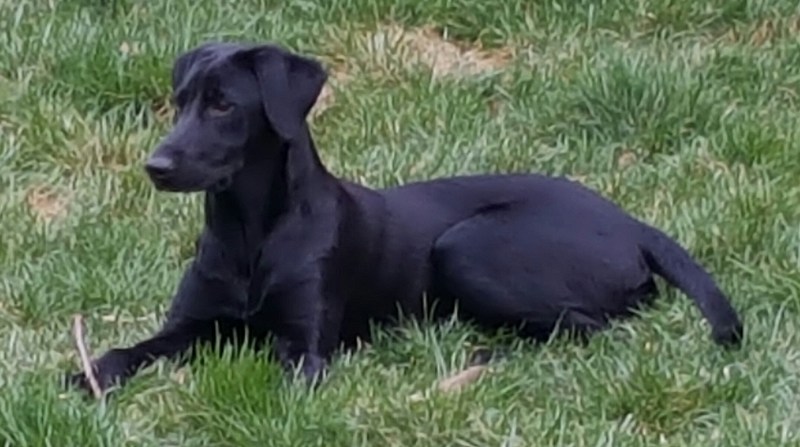
Lightning is still small compared to the dogs in Mike’s videos; he weighed in at 44.2 lbs this morning. But he’s in excellent health, has endless enthusiasm for the retriever games of catch and fetch, always exhibits great drive in his training retrieves, and is in every way a delightful companion.