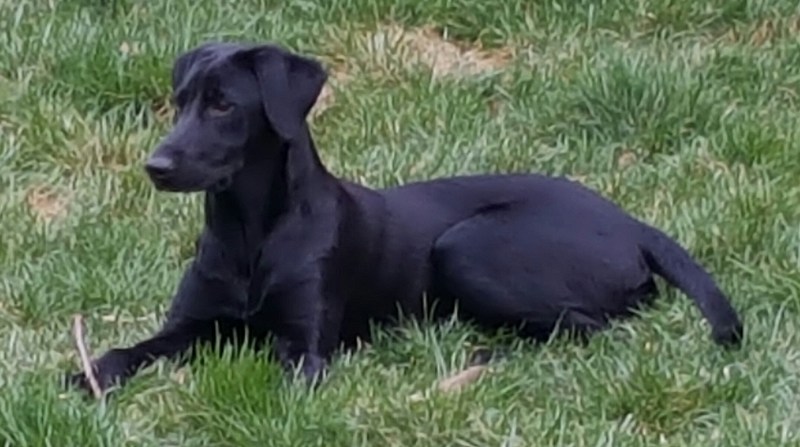
[This post will eventually be moved to a separate website, since it is on a broader topic than just training Lightning. But for now, I hope you don’t mind that I’m stashng it here.]
In early training of retrievers, and I guess all trained dogs, one of the primary training objectives is known as “Intro to obedience.”
“Obedience” in turn typically means three skills for the retriever: Heel, Sit, and Here. Obedience may include other skills in other sports, such as “Down”. Some trainers also train “Stay” as a separate cue, while many consider it implicit in the cues Sit and Down. For example, I don’t train Stay because when I say Sit, I mean “sit till I give a different cue.”
“Here” is the verbal recall cue used for retrievers, with a come-in whistle as a synonym. Other sports and activities use other cues, such as the dog’s name, or “Come”, or other kinds of whistles.
All of the obedience cues are of fundamental importance for the field retriever and deserve discussion, but recall (Here) is in a class of its own. So before even addressing how to train it, I thought I’d outline why it’s so important in this sport. Recall is used for all of the following:
- Complete the retrieve —
- Recall from trouble, during competition or everyday life —
- Handling on blind — [whistle version, often in combination with angle direction]
- Handling on mark —
- Foundation for steadiness as a controlled break —
- Time to depart the scene —
- Abort the retrieve —
[In a future version of this article, perhaps I’ll fill in more detail on items above.]
All of that, just from one cue!
But a reliable recall is difficult to achieve. The proof is in how often even advanced retrievers refuse the command at training days and during competitions, and in how many systems, including full-blown courses, designed to produce a rock solid recall are published.
But as the outline above illustrates, the benefits are both plentiful and vital. I would go so far as to say that a retriever’s pre-teething program that accomplished nothing but a reliable, well-proofed recall from field-retriever distances would reasonably be considered a rousing success, even if none of the many other early training goals had been gotton to.
Traditional trainers often use an ecollar to strengthen the recall, and in some cases even to train it. Though not necessarily a perfect recall, that method can humanely produce a high quality recall in a matter of hours.
For that reason, it is sometimes difficult for traditional trainers to understand why a positive-trained dog doesn’t always come when called. This can cause conflict at training days, so if you are using a PRT approach, I’d urge you to brace yourself. It may take you many months of hard work to instill the recallability that will be expected of your dog, no matter how your dog excels in other facets of the sport.
In future posts, we’ll talk about how to go about it. Oh yes, it can be done.
 Lightning's Journal
don’t know if it’s ’cause you’re feeling better, or the new phone, but ti’s good to see this post.
LikeLike
Thanks, Jody! I’m seeing a surgeon about my spine on Thursday, and can only work lying on my back, but I stopped taking the Rx a few days ago and it’s helped clear my mind.
Obviously this is a topic I’ve thought about a great deal. To me it seems fairly complex, and I wanted to get my thoughts down.
I continue to pray for you and your son Kenny, since I know he is also dealing with a spinal injury. Please let me know what you learn from his visit to the doctor.
Love,
Lindsay
LikeLike