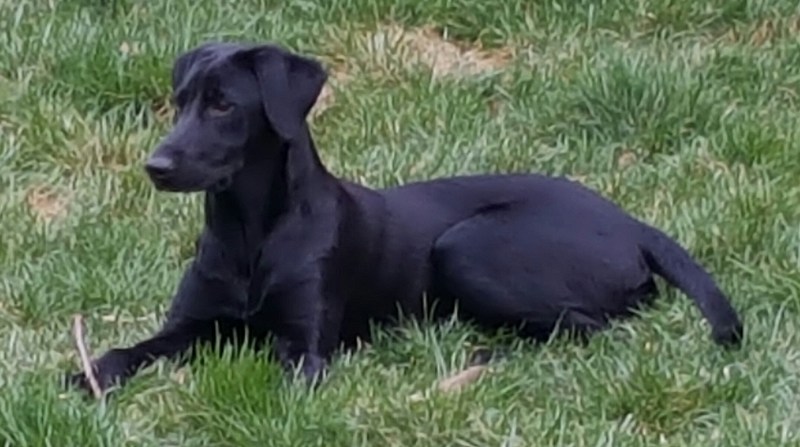
My grandson Gavin is visiting for Christmas. The combination of a 5yo (his birthday was yesterday) and two puppies is explosive, but they’d had a day to get used to each other. So when Gavin asked if we could train Lightning, I thought this might be an opportunity to get help with some indoor clicker training.
Next up on my training queue was Sit, so we’d train it first with a visual cue, then with a verbal cue. I didn’t know it, but we’d also end up training something special I hadn’t planned for the first session.
I experimented with letting Gavin do the clicking, his preferred task, but he couldn’t get the timing right. After a number of late clicks, I gave him the new job of feeding treats. Eventually I also had him try giving the verbal cue, with some success.
I you perform an online search, you’ll probably see a number of approaches for clicker training a sit. We used this one:
- Gavin tore up some sliced ham into small pieces, about inch-square, which we would use as our high value treats.
- I recharged the clicker: click-treat three times to kick off the session.
- With my empty hand in a cupped shape, I moved around until Lightning was on his feet, then moved my hand over his head, palm up. He followed it with his eyes, which caused him to sit down. Click treat.
- I repeated that a couple of times, and then tried the gesture without actually moving my hand over his head. He sat down. Click treat. Now we had a visual cue for Sit.
- I said “Sit” and waited a second, then used the visual cue. He sat. Click treat. I repeated that a few times, and soon he began to sit as soon as I said Sit without waiting for the visual cue. Now we had a verbal cue.
- Dog minds are different from ours in many ways, and one of those is that when they learn something, they learn the entire context, not just what we consider salient. As a result, Sit, like any other cue, would need to be proofed for both location and distractions. It might even need to be retaught in several locations before the dog generalized it.
- So Gavin and I refreshed our supply of treats, providing a valuable break in the session.Then we moved around the play room, practicing verbal Sit in one location after another. I usually gave the cue and clicked at the moment Lightning sat down. Gavin dispensed the treats.
- I soon noticed that having Gavin giving the treats meant that Lightning did not need to be responding to the Sit cue while physically close to me, nor in a “front” position. He could be in any part of the room, facing in any direction, when I cued Sit and clicked, and would not be motivated to come to me for his treat because Gavin would be right there. So now, though I had not planned it, we had a remote Sit. That may or may not have much value for a pet dog or in some dog sports, but it’s hugely valuable for a field retriever because it’s a key component of handling skills. In time, Lightning will be cued to sit hundreds of yards away from where I’m standing. We had now laid the groundwork for that skill. In fact, no reteaching had even been needed. Lightning had come to understand Sit as a remote cue in his first session.
Of course we’re not done with proofing Sit by a long shot. Lightning will be practicing that cue for the rest of his life, and if he’s like other dogs I’ve known, he’ll even forget what it means occasionally, despite my best efforts to reinforce it consistently and my attempts to make it reflexive. After all, dogs are always basically guessing at what we mean by our attempts to communicate. Sometimes they draw a blank or guess wrong, and of course sometimes the context they are in produces a different outcome than we intend.
Nonetheless, Gavin and I had given Lightning a good foundation for Sit in our training session on Christmas eve. I think it was fun for all of us.
 Lightning's Journal
Playing catch-up with your blog: 2 puppies and a! toddler sounds like priceless video and photo opportunities!
LikeLike