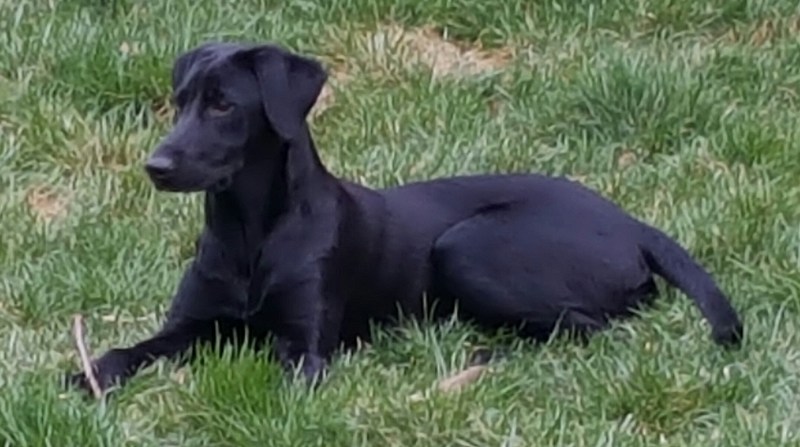
If you’re using Lightning’s journal as a guide for training your own dog, you are probably aware that we are still in the first stage.
I‘ve characterized this elsewhere as the pre-teething stage, but I think calling it Stage 1 is a better designation. That is, if I were training an older dog already past teething, I’d still start with the same training.
In Lightning’s case, all his adult teeth are in, but circumstances have prevented me from giving Lightning as strong a foundation in some of this work as a dog being trained by a professional with a staff, a training property, and a location in good weather for swimming — in other words, one kind of dog I expect Lightning to someday be competing against. So rather than rush into Stage 2, I’m continuing to strengthen Lightning’s foundation with some of our Stage 1 items.
The Stage 1 list for my Positive Retriever Training (PRT) program is made up of the 18 items on Mike Lardy’s “Socialization and Introduction to Field” at the top of his TRT Flow Chart (you can view it with an online search), plus some additional items of my own. Here then is a rundown of the PRT Stage 1 items and how Lightning is doing with each one. If you’re following this program, hopefully your list looks similar.
First, Mike’s items:
- Introduction to Crate. Lightning has completed this item. I serve his meals in a crate indoors, he sometimes goes in there to nap on his own, and he rides in a crate in the van.
- House Breaking. Lightning has never pooped indoors since I’ve had him. In addition, he nearly always pees outside, but he still makes mistakes indoors. One kind of mistake is when he gets excited with a new visitor petting him. My holistic vet says this is involuntary and will probably pass as he gets older and more confident with strangers. The other kind tends to happen after a rough-housing session with Ryley, DW Renée’s 8mo Golden. It’s easy to prevent. I just need to get Lightning outside immediately after they’ve been playing, but sometimes I’m too slow. This is a training issue and will hopefully be completed someday.
- Playing with Kids and Adults. Lightning’s been around kids, adults, and other dogs. He’s crazy about all of them. I don’t see this item as needing additional work other than in the normal course of events.
- Traveling in a Vehicle. Lightning rides in a crate in the van, sometimes for hours at a time. He readily leaps in and out of the crate on cue. My verbal cue is “hippity-hop” rather than the more usual “kennel”. My visual cue is a sweeping hand gesture. When we ride in Mommy’s car, Lightning and I sit in the backseat with one of the other dogs without difficulty. So I consider this item completed.
- Learning Limits. Lightning has several examples of this. For one, I can call him away from a play session with Ryley and he’ll curl up at my feet (that is, on my feet) or on the couch and ignore Ryley’s attempts to re-engage him unless I release him with a verbal “OK”.
- Nature Walks. Lightning and Laddie play in the woods behind our house many times a week. My back injury, and later the winter weather, prevented me from hiking until recently, but now we’re getting out frequently.
- Simple Obedience with Treats. For a field dog, I think the primary obedience skills are Here, Sit, and Heel. I originally clicker-trained all of them using treats, and Lightning has considerable experience with them, but they’ll always need more practice.
- Casting Games with Treats. I’ve never quite understood what Mike means by this, so unless it happens to coincide with other work we’ve done with body language such as sweeping hand gestures, this may be an omission in our Stage 1 work. Hopefully it’s not a serious hole in Lightning’s training.
- Walking on Leash (2 sides). This is a work in progress. By the way, I always try to balance all our training on both sides.
- Introduction to Retrieving. This has always been my major focus, and Lightning has had scores of training sessions running marks.
- Introduction to Birds. I often bring thawed birds for Lightning to retrieve, and he recently had his first flyer at a club training day.
- Introduction to Water Retrieves. We finally got this item covered yesterday, as described in my previous post.
- Introduction to Gunner-thrown Marks. Lightning has had this work in several guises. Whenever possible, I bring one or more assistants to our training sessions and they throw marks using blank pistols as gunfire. When I can’t get even one assistant, I use poorman singles, again with a pistol, or, if that’s not possible in a particular location, hey-hey-hey. In addition, of course, Lightning ran three gunner-thrown marks at the club training day last weekend.
- Introduction to Gunfire (at a distance). Lightning has months of experience with blank pistols, and additional experience with shotgun fire this last weekend.
- Introduction to Upland Hunting. I’m not a hunter, so this will be an omission in Lightning’s training.
- Introduction to Lead Steady. I’m not clear what Mike has in mind for this item, but I place a premium at this stage on developing Lightning’s motivation, so I may be de-emphasizing steadiness more than Mike does at this stage with his dogs. Or maybe not. In any case, Lightning has always run outdoor retrieves wearing a check cord used to hold him till the handler releases him, and we generally don’t call for a throw until Lightning sits on cue (I use a whistle Sit these days). In addition, Lightning is required to wait until I return to his side and send him on poorman marks. So hopefully we’re covering this item enough for the present stage of training.
- Walking Singles. This is the primary way we practice retrieving when I have a single assistant.
- Yard Multiples. I’ve worked with Lightning on doubles in the house, in our yard, and in other fields, but after several sessions a few weeks, I’ve mostly discontinued this. As I discussed in a recent post, I’m more concerned at this stage with Lightning learning to lock in and give his full attention to every throw, rather than possibly impairing that training by having him practice multiples. He did have an introduction to the concept, and he’ll still get a few more as we continue Stage 1. Of course in later stages of his development, he’ll get a great many more multiples in many configurations over the years.
That completes our survey of Mike’s items. Now some additional Stage 1 items of my own:
- Selecting the puppy. This of course precedes any training. I discussed it in one of my first posts for this journal.
- Vet appointments. This is for exams and vaccinations. I rely primarily on a well-known holistic vet in our region, who I’ve been taking my dogs to for more than a decade. For emergencies, we’ll use a local conventional veterinary practice we like, and we have a number of specialists we’ve found over the years we can go to when needed.
- Handling paws, ears, etc. Lightning was always comfortable with most handling, but he didn’t like his paws and toes handled at first. Other dogs might have other sensitivities. The earlier the puppy has an opportunity to become comfortable with all kinds of handling, the easier it will be for you, vets, and others to care for him.
- Nail trimming. As I mentioned in a recent post, I waited till Lightning was six months old to get him comfortable with having his nails trimmed with a Dremel. It only took about a dozen sessions spread over a single day. I suspect it could and should be done earlier if possible.
- Socializing: puppies, adult dogs, other pet species, horses, children, other races, men, women, hats, umbrellas, back packs, trash cans, etc. I’ve broadened the socialization items from Mike’s list, and I look for every opportunity to give Lightning new, enriching experiences.
- Tug. I used to play a lot of tug with Lumi and Laddie, knowing that it’s a major tool for building motivation for some sports such as agility and Schutzhundt. I have taught the game to Lightning, and he sometimes plays it with me and with other dogs. However, I’m not convinced that Lightning considers it a major reinforcer as the Goldens did, and therefore I’m not sure it matters much for building motivation for the retrieve in Lightning’s case. This may vary with different breeds as well as with the individual.
- Catch. A few weeks ago I taught Lightning to catch a tennis ball in the air. This is a game he seems to love, often initiating it on his own. As mentioned in an earlier post, I consider it a valuable game for a retriever for a number of reasons. I intend for Lightning also to learn to catch thrown treats, but we haven’t worked on that much and I don’t consider it as useful as playing catch with a ball, since treats don’t have the delivery-to-hand component.
- Leave it. This is a secondary but invaluable obedience cue, as discussed in an earlier post. As with other obedience work, it’s a skill to train early in the dog’s life and continue practicing for a lifetime.
- Stay on mat. This is a special case of Mike’s “Learning Limits” item. I’ve trained my other dogs to stay on a mat away from me for long durations, and I think it’s an invaluable skill. But I think Lightning had gotten the same training benefit from the kind of thing I described under “Learning Limits” above. He seems to have a natural stay.
- No jumping up unless invited. This is a work in progress.
- No counter surfing. Another work in progress. Lightning rarely counter surfs, but he has destroyed a few items he should have left alone.
- Charge clicker. As I’ve described previously, I like to recharge the clicker frequently when we use it. But I’m finding fewer uses for a clicker at this point in Lightning’s training.
- Hand touch. This is the first cue I like to train with a clicker, but I also like to continue practicing it, since it strengthens the dog’s response to sweeping hand gestures. I still practice it with Lightning sometimes.
- Wearing the dog. The value of tethering cannot be overstated. It can be an enormously valuable tool for several behavioral issues, and I think all my dogs are more responsive to me because of it. However, Lightning is extremely thin-boned and I’m afraid he’s more fragile than the Goldens around his neck. Since he seems to have become a Velcro dog anyway, I rarely tether him indoors.
- Visual Sit, verbal Sit, remote Sit, whistle Sit. This item is another special case of one of Mike’s items. I consider these to all be skills taught and practiced during Stage 1 and have done so with Lightning.
- Two-sided heel with automatic sit. This is another special case of one of Mike’s items. As I’ve described in previous posts, I’ve trained and continue to practice this with Lightning in several variations, such as walking at heel, coming to heel from a front approach, and swinging from heel on one side to the other.
- Practicing retrieves from a mat. I often bring a rubber mat to the start line when practicing retrieves with Lightning as well as Laddie. Like a novelist or screenwriter using a knife or other object to focus the reader’s attention, I believe a mat helps a retriever conceptualize both the beginning and end of the retrieve pattern.
I think that covers most if not all of the training items in PRT Stage 1, where Lightning, who just turned six months old, is continuing his daily training.
 Lightning's Journal
We solved the excitement urination indoors when people visited by playing Invisible Dog. The was excruciatingly difficult for the people. But basically, for the first 5 minutes, people have to walk, talk, and behave as if there is no Lightning. No looking at, no talking to, no petting, no stepping over, nothing that indicates any awareness of Lightning. Then after the 5 minutes, the people can very calmly acknowledge Lightning’s existence. Took our dog less than a week to stop the excitement urination. But wow, was it hard for the people.
LikeLiked by 1 person
Thanks, Patrice! Great contribution!
LikeLiked by 1 person
And beautifully written, too, I realized!
LikeLike
I have a question about using the mat to conceptualize not just he beginning but also the and of the retrieve. Does that mean that you encourage Lightning back to your side to deliver the bumper rather than in front?
LikeLike
Hi, Jane. Sorry I wasn’t clear about the mat. I simply meant that it helps the dog conceptualize the retrieve pattern: go out, pick up the bird, come back. That’s as opposed to going for a swim, parading, visiting spectators, dropping the bird early, etc.
As I might have mentioned in one or more of my posts, I don’t believe in requiring a retriever to give up the article when he/she returns during Stage 1, so I won’t be training a delivery till the beginning of Stage 2. Initially “Out” will be from front but we’ll proof it for other orientations, including heel position on either side. In competition, I’d rather have delivery at heel but if I’m afraid the dog might drop the bird, as I often am with Laddie, I’ll just take the bird as he approaches from front.
As for where Lightning is right now in his training, I found that since he’s anxious to drop the bumper and shake off after he gets out of the water on a water retrieve, it’s an opportunity for me to let him deliver to hand, and I take the bumper as he approaches me. I’m not using a mat for water yet; he just started swimming two days ago.
For land retrieves, which Lightning has been doing for months, I don’t ask him to deliver to hand. I call him close to me and try to get him lined up for the next throw. Then I wait for him to drop the bumper. Over time he’s gotten an increasing understanding of how to come up beside me, drop the bumper, and either sit on his own or when I blow a whistle Sit. I try to call for the throw the instant he sits and/or drops the bumper, whichever happens last. I don’t require that he actually be on the mat, and I don’t require any steadiness. He generally takes off as soon as the gun fires, then adjusts his line when he sees the trajectory of the throw.
To be clear, I’m not trying to train Lightning any sort of formal retrieve at this stage. Rather, I’m trying to facilitate his discovery of an ever-deepening love of retrieving within himself. I don’t want anything to detract from that discovery process.
Thanks for your interesting question. I hope I answered it.
LikeLike