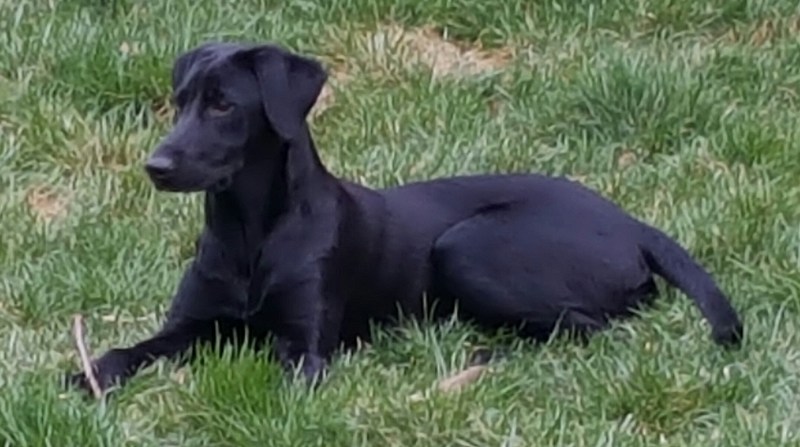
For both of my Goldens, land-water-land (LWL) retrieves were a training challenge. The problem was getting back into the water carrying the bumper or duck after picking it up. Lumi had difficulty at first, but learned to do it fairly quickly. Laddie could do it when he was a puppy, but about the time he turned a year old, he stopped being able to do it and it took me months to figure out how to solve the problem.
Now it was Lightning’s turn. Since he was pretty comfortable with open water retrieves during his first two swimming sessions, for his third session today I thought I’d see how he’d do with some LWL retrieves.
First I packed a long line into the van. If it turned out Lightning was unable to come back across a channel, I’d be able to attach the line to his harness and gently draw him back into the water. That’s the approach that finally worked with Laddie so many years ago, and remarkably, he never needed help with it again after the first time I did it.
Then I picked up two assistants, Peter and Annette, after their classes and work were over, and drove them with the dogs to the training property closest to where I live. Unfortunately, with rush hour, it was a two hour drive, leaving us less than an hour of sunlight to train. That would only leave time for one session for each dog.
First I ran Laddie on a water double and a big water blind, the three retrieves all involving several water re-entries and other challenges. Though it was Laddie’s first water series since last fall, he did a nice job.
For Lightning’s turn, I asked Peter to throw for us and gave my phone to Annette, who I’ve found to be a gifted videographer, so she could take videos of Lightning’s work.
As with Lightning’s previous two water sessions, I didn’t put on his harness and check cord. I didn’t think he’d attempt to play keep-away, and I didn’t want to get the equipment wet unnecessarily.
I started with a straightforward training plan and was prepared to make adjustments as needed once I saw what difficulties Lightning would have. But I didn’t need to make any adjustments. Lightning accomplished each step with little difficulty. Although the plan was pretty obvious, I’ll describe it in case it’s helpful for anyone.
First I chose a water crossing about 20y across, with a low shore on the far side and no obvious way to run around the water. Peter stood on the far shore and threw bumpers when I called for them, firing a blank pistol with each throw. I ran Lightning from a mat 10y from the water on our side, as usual only requiring him to sit in order for me to call for the throw. He would launch excitedly on each gunshot, then adjust the direction he was running once he saw where the bumper was being thrown. We’re not working on steadiness yet.
The first throw required him to swim about two thirds of the way across the channel for an open water retrieve. He ran to the water, but having only swum in one location before, he needed some time to run up and down the shore a bit before getting in this new water. Once he waded in, he seemed to have lost track of the bumper, so I had Peter fire the pistol and throw another one, a bit closer to us this time. Lightning grabbed that one and brought it back to me.
I then asked Peter to pick up a rock and throw it to the bumper still in the water to attract Lightning’s attention. But before Peter had a rock ready to throw, Lightning darted into the water on his own and headed for the bumper. I told Peter not to throw the rock after all, and Lightning brought me the bumper a moment later.
The third throw was right at the shoreline, and the fourth was a foot or so inland. Lightning had no difficulty with those. Finally I had Peter throw his fifth bumper to the base of a tree standing further back from the water, about 10y.
Lightning ran, swam, and ran straight to the bumper, picked it up, and raced back toward me, but when he got back to the water he stopped. I whistled come-in and called Here. He ran up and down the shore a couple of times, then finally waded into the water and swam back. We ran one more retrieve in that location and Lightning got back in the water on the way back without hesitation.
We still had some sunlight so I decided to increase the challenge a bit more with a new location. This time:
- The land entry, from the mat to the water, was longer and the embankment down to the water was steeper.
- The embankment on the far side was quite steep.
- The throw would be over the far embankment, so once it landed, it would be out of sight until Lightning got close to it.
Here’s Annette’s video of how Lightning did:


Wow! Who taught Lightning to swim? Good job.
When I was taught to swim, I was told not to hold my head up and to kick my feet.
Lightning seems to have developed a different, but effective style.
LikeLiked by 1 person
I’m almost sure you’re kidding, Dr. Wieder. Many dogs are natural swimmers, and some breeds, including Goldens and Labs, have the added advantage of webbed feet. You can’t see it in the video, but they do kick with their back feet and legs, as you were taught to do.
When puppies first learn to swim, they typically splash quite a bit with their front paws. At some point, however, they learn to keep their front paws underwater.
Humans sometimes use a “dog paddle”, which is similar to the way a dog swims. As far as I know, however, it’s not one of the strokes used in the Olympics.
LikeLike
You are right. I was kidding. I am however, somewhat jealous of you. You obviously found something you love doing. I’ll keep looking.
LikeLike