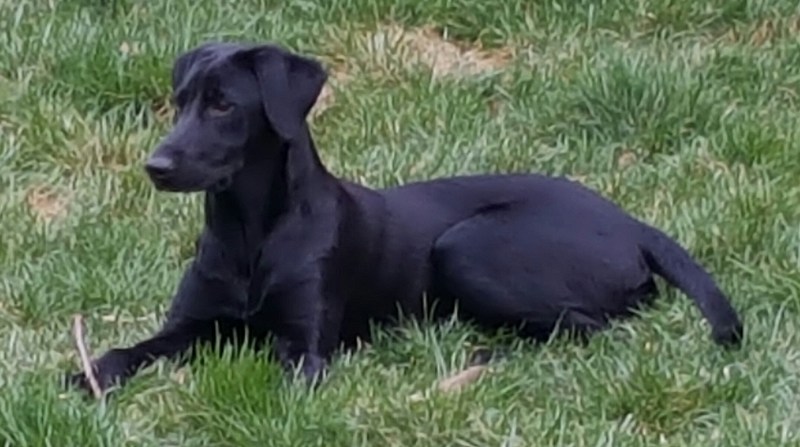
This morning was gloomy and damp with temps in the high 40s, and I wasn’t able to arrange for anyone to train with, but the dogs and I still had a good session.
First, I ran Laddie on a 300y+ blind through areas of knee-high grass and next to a line of trees.
Next I tossed a variety of bumper sizes and colors in a rough oval and had Laddie lie down in the center, and ran Lightning on a Walking Fetch proofing drill using that course. I heeled him on both sides, and I used all three variations of the drill — Fetch/Sit/Drop, Fetch/Heel/Here (past Laddie and one or more other bumpers) /Sit/Drop, and Here (without picking up a bumper) /Sit. I reinforced with bits of Muenster. Lightning’s performance was enthusiastic and sound throughout, and on top of the other Walking Fetch proofing setups we’ve run the last couple of weeks, I feel that Lightning is now ready for the next step in Stage 2 of our Positive Retriever Training (PRT) program, Simple casting.
The video segment “Simple Casting” in Mike Lardy’s TRT video, upon which PRT is modeled, is a masterful example of how to train skills, and casting skills in particular, incrementally. Watching it also gives you a sense of what to expect in your own dog’s work and the typical pace of progress over several days.
In Lightning’s case, after our morning session, Lightning and I reviewed the video and then started the training in our yard. Lightning was very interested in the video. He even tried to retrieve Mike’s bumpers on the screen twice!
I only saw a few changes to Mike’s approach that we’ll use for simple casting in PRT:
- When working with a single bumper in one of more positions, we won’t use a line. We’re looking for solid responses to Here after each retrieve without physical enforcement.
- We’ll use treats as little or as much as needed to optimize performance. In Lightning’s case, the fetches may be so self-reinforcing that treats would be a distraction, but we’ll use them if we see performance drop.
- Of course we won’t use ear pinches. Treats play the corresponding role of reinforcing the Fetch in PRT.
As Mike explains in the video, about halfway thru the simple casting progression, we begin to use piles of bumpers rather than single bumpers. At that point, even in PRT, we want the dog on a line so that we can gently draw the dog away from the pile if necessary, not giving the dog an opportunity to shop.
I’m out with the dogs so much that, even though Lightning has officially been working on Walking Fetch, I’ve often cast him to bumpers lying in the field to save myself having to go and pick them up. Therefore, Lightning was readily able to do all the single-bumper variations Mike illustrates in the video in his first session. I only needed to switch verbal cues to “Over” and ”Back”. That was easy because Lightning didn’t really care what the verbal cue was, he was just looking for a release signaled by my body language so he could dart to the indicated bumper.
We’ll put on Lightning’s harness and check cord and begin working on casting to piles, continuing to follow the steps Mike explains in the TRT video, in our next simple casting session.
Update: As we worked thru the entire progression over several sessions, at one point I tried something with Lightning that Mike doesn’t do on the video: I made piles with collections of different sizes and colors of bumpers, including 3″ bumpers with ropes and streamers. Lightning’s performance deteriorated. But in the next session, I first tried one more time sticking entirely to 2″ white bumpers with ropes but no streamers. Lightning’s performance improved again immediately. Lightning is fine retrieving 3″ bumpers with ropes and streamers for marks in our field work, and I think they improve visibility and can even help improve a dog’s marking skill. But I wouldn’t use them, or any other distracting article, for the simple casting drill again.
 Lightning's Journal
Love Lightning enjoyed the video, especially his wanting or trying to retrieve the dummies
LikeLiked by 1 person