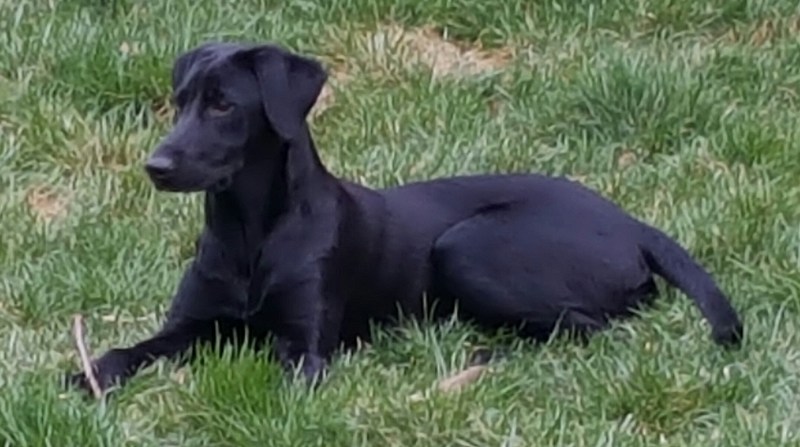
Until this point, the Positive Retriever Training (PRT) I’m developing has closely followed Mike Lardy’s traditional Total Retriever Training (TRT) every step of the way through Mike’s Basics stage and PRT’s Stage 2. Now it’s time for PRT’s Stage 3, modeled on Mike’s Transition stage in TRT.
Actually, Lightning has not yet completed the swim-by drill, the last step of PRT Stage 2, because of logistic issues, but we’ll get to that as opportunity permits.
Meanwhile, however, continued work with Lightning on PRT Stage 3 handling drills, in parallel with continued development of marking skills, had been interrupted by a confusing phenomenon: Lightning, just having turned a year old, and despite a thorough foundation in carefully sequenced training objectives, has suddenly become unreliable on his returns. Sometimes he runs a nice retrieve, whatever the setup we happen to be working on. Other times he completes the outrun well, but then picks the bumper or dokken up by its rope and darts off in the wrong direction, sometimes embarking on a merry chase all over the field, completely immune to whistle or verbal cues. He looks like a complete beginner. It’s difficult to believe this is the same dog who was running the double T and 300y marks without such misbehavior a few weeks ago.
After much thought and seeking of solutions, not necessarily a waste of time but not fully resolving the issue, I’ve begun to focus on a comment my friend Jody Baker made when I introduced the issue of zoomies some time ago. Based on her work with dogs in other sports such as agility as well as field work, Jody commented that stress can be a major factor in why such behavior occurs.
Pursuing that line of thought, I’ve recently experimented with temporarily terminating Lightning’s training on handling and instead used all of our training time for marking practice. After some initial remedial measures, such as having Lightning wear a long line and using food for reinforcement of good returns, Lightning’s returns are gradually improving. The last two days, he did a number of singles and doubles, including a couple of retired singles, mostly with solid returns.
Based on this experience, combined with extensive previous experience with Lumi and Laddie when they were at the same stage in their training, I’ve come to the conclusion that PRT Stage 3 should diverge from TRT Transition in a significant way. I’m particular, PRT Stage 3 should begin with the focus entirely on marking, enabling the dog to develop a far stronger positive association with high quality returns than he/she had developed up until this time. Those returns need to be trained not only as a skill, but as a deeply embedded motor pattern that can withstand the disruption of stress when it starts to become part of the dog’s training for handling.
The reason that this isn’t an issue in TRT and other traditional programs is, I believe, because the ecollar is used to enforce a quality return. Stress or no stress, the cost to the dog of a poor return is too high a price to pay.
But for a positive trained dog, no price is extracted for a poor return. It is entirely the dog’s choice. Perhaps a treat is withheld or a long line is used to enforce the return, but to the extent that the dog is able to express his/her preferred behavior, a return directly to the handler with the article ceases to become the dog’s first choice once stress issues start to become associated with the work. Zoomies become a way to avoid and dissipate stress. And as trainers, we don’t want that behavior chain to become entrenched.
Fortunately, it appears that the behavior can be reversed by terminating the parallel stressful training (diversion drills, for example) and focusing all our training on marking skills. The idea is that, after some period of time, solid returns will become so deeply embedded in the dog’s behavior that training of handling skills can resume without losing the dog’s ability to perform high quality returns.
This is a fundamental change to PRT as I’ve been presenting it, and this change means that Lightning’s training is not a perfect example of PRT training, since Lightning and I have engaged in training handling apparently before Lightning was ready. Hopefully I and others using PRT for other dogs will avoid this mistake by deferring the introduction of stressful drills until the dog’s marking and return skills are more extensively practiced.
Accordingly, I will sort this post out of order in the Table of Contents so that the reader will encounter this discussion before reaching the posts on training objectives I now think should be deferred. I’ll also try to develop a sort of litmus test for how to judge when it’s time to begin the handling drills. At this writing, I don’t yet know what that test is.
 Lightning's Journal
Good post about. Stress.
Sent from my iPad
Jody Baker
>
LikeLiked by 1 person