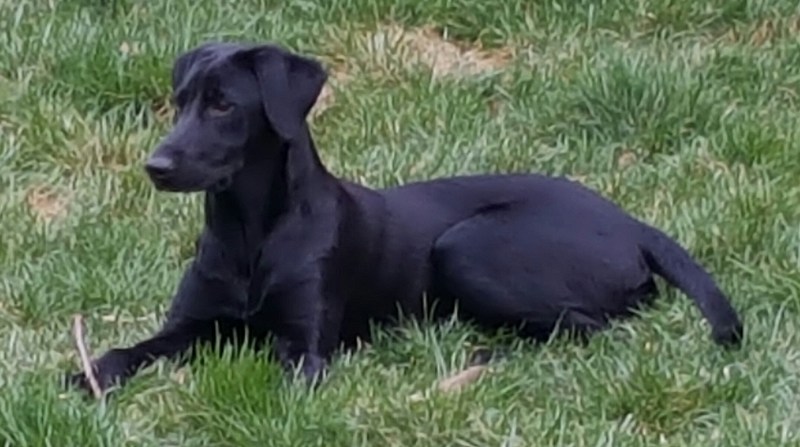
Based on Lightning’s earlier progress, I thought he would be further along in his retriever skills now that he’s reached fourteen months of age, and has been with me a solid year. But actually, he went backwards in his training a few months ago and we’re only partway to recovering.
Some of the reason, I think, was because of health issues. Lightning developed a serious bacterial infection several months ago that caused hair loss on his entire undercarriage, as well as some larger lesions on his right wrist and elbow. When the first antibiotic prescribed by the vets didn’t work, we got a lab test that showed the infection was resistant to almost every antibiotic in use for dogs. But we began a second antibiotic, one of the few to which the infection is susceptible, though so risky for side effects that I was required to wear gloves when handling the tablets.
Two courses of that, along with a number of other sprays, shampoos, and ointments, made good progress in fighting the infection, but Lightning wasn’t allowed to swim for months. That was unfortunate timing for his training given that we can’t swim around here when the weather is too cold, so he’s lost nearly a year of water training. But that wasn’t the only problem.
It turns out the new antibiotic affected Lightning’s liver function, which apparently lead to nausea, which lead to a loss of appetite, which lead to weight loss. Already tiny and skinny, he dropped another three pounds, getting down to 41lbs in weight. Of course we stopped the new antibiotic immediately and began a new medication which, after several weeks, seems to have repaired Lightning’s liver function.
His appetite, however, is not completely restored, though he never really did have much of an appetite. The weight loss issue put me in the middle of a disagreement between the two veterinary practices I use, both of whom I highly respect. At the conventional practice, one of the vets blamed Lightning’s weight loss on his raw diet, which was true to the extent that Lightning’s nausea made raw food unappealing, but the best also attributed other problems to feeding raw, which IMO he had no evidence for. Like many conventional vets, the vets in that practice don’t think well of raw diets. So he directed me to switch to kibble, which indeed Lightning was more willing eat, provided I hand fed him.
But when I brought Carol, my holistic vet, up-to-date on Lightning’s condition, she disagreed pretty adamantly with feeding Lightning kibble. I don’t see how it can be that bad, since many dogs, including performance dogs, seem to thrive on kibble. But I place my trust in Carol and she said that if Lightning wouldn’t eat the frozen raw food he used to eat, which didn’t surprise her given his liver condition, I should feed him home-cooked or commercially cooked raw food. Carol doesn’t like microwaves, but I’ve gradually developed ways of preparing the food, using both a microwave and a stove-top skillet, that make the food palatable to Lightning. As his liver recovered, his appetite has partially returned and he sometimes eats his raw food frozen as before. The rest of the time, I cook his food and he’ll usually eat that, though sometimes again only if I hand-feed.
Carol also had me start Lightning on a probiotic and an herbal supplement, both powders. And since Lightning’s lesions still weren’t completely healed, I took him to a veterinary dermatologist. The specialist was supportive of all the previous treatments Lightning had received, but changed us to a new group of medications that he seemed pretty confident would complete Lightning’s recovery. Indeed, Lightning’s undercarriage is now healed with most of the fur grown back, and the lesions on his wrist and elbow are on the mend. He’s also allowed to swim now, but it’s pretty much too late for water training around here till next spring.
As for how all this affected Lightning’s land training, that’s difficult to say. Everything was going well a few months ago, as we completed PRT Stage 2 and began Stage 3, corresponding to Transition in traditional programs like Mike Lardy’s TRT. However, suddenly Lightning’s returns fell apart. He could mark well on both singles and doubles at good distances and with the introduction of some factors such as hills and strips of cover, but he stopped bringing the article back. Instead, he’d pick it up, often carrying it incorrectly such as by the rope, and run all over the field and into the woods, ignoring all his trained cues and playing keep away if I approached. He’d tear up birds.
The road back has been long and arduous. Among the many methods I’ve tried to resolve the issue:
- Reinforcement for returning with bites of deli meat I tis to him after a nice delivery
- A long, 60′ line along with short, 20y throws so that I can hang on and reel Lightning in if he gets the zoomies
- A short, 15′ line attached to his collar, along with increasingly longer throws; apparently, this sometimes seems to make Lightning believe that he won’t be able to get away so he makes a good return, but unfortunately it doesn’t always work
- Cessation of most yard work, though I do throw in a cold blind of around 100y from time to time; my feeling is that, besides health issues, some of Lightning’s behavior was the result of stress caused by the additional complexity of training on both marks and blinds simultaneously, so I’m trying to eliminate stress as much as possible for now, though he seems to enjoy the occasional blind and that’s let us practice a bit on whistle sits and casting
- Training with simpler articles such as 2″ white bumpers with the ropes removed, then adding increasingly complex articles, including dokkens, in a series of marks at varying distances; I’ve also tried birds but he still won’t carry them properly, though he had learned to when he was younger
This is very much a work in progress, with good days and bad days. The good days encourage me that soon we’ll be able to resume progress on our planned PRT program, to further develop his skill in land marks and blinds, plus water retrieves in the spring. On the other hand, the bad days are frustrating and discouraging. I don’t have a crystal ball; I wish I did. For now, I’m just trusting that eventually the good days will win out.
 Lightning's Journal
Hi Lindsay,
I have been following your blog and, just want to wish you luck with getting Lightening back to full health again.
Regards,
Sue Williams
http://www.rotoruagundogclub.weebly.com
New Zealand
LikeLike