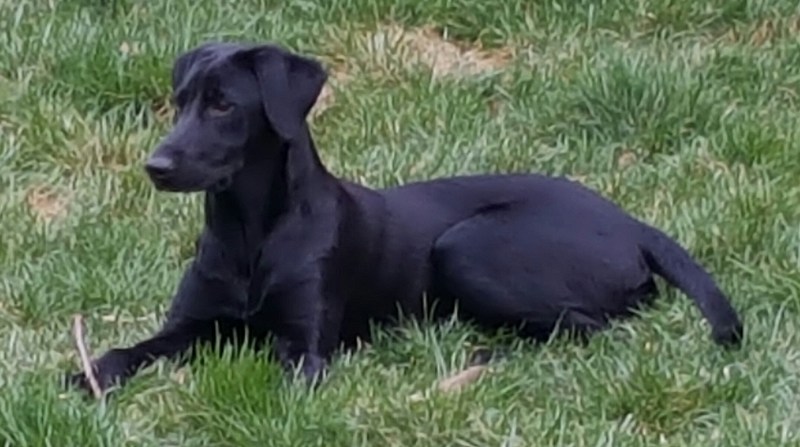
Over the last three months, I’ve run dozens of experiments attempting to repair Lightning’s returns on retrieves and train him not to go into a game of keep-away once he’s picked up the retrieval article. I’ve described some of my observations in previous posts, but we’ve made progress since the last one so this is an update.
We are now at the point where Lightning can run fairly advanced marking setups, including triples, retired guns, and mama-poppa doubles, with factors such as wind and strips of high cover, at distances of 200y and more. Lightning is able to run good marks with thawed ducks as well as duck and pheasant dokkens and bumpers.
However, he isn’t reliable at the beginning of a session and may go into keep-away with the first few retrieves. Therefore, we first need to go thru a process I call a retrieve tune-up. Once the tune-up is complete, Lightning stops switching into keep-away mode and we can run normal marking practice.
The retrieve tune-up is performed as the following steps:
- Throw the dog’s ball for him a few times. Of all the reinforcers we’ve used, only two have worked well with Lightning. One was a small animal carcass he had found that only lasted a couple of sessions but was extremely valuable to him while it lasted. The other is a red rubber ball, similar to a Kong but round. Occasionally I forget to bring the ball out for the session and Lightning immediately starts playing keep-away on his returns. As soon as I bring the ball out, that stops.
- Run the dog on a 60′ long line on marks up to 20y, with the handler holding onto the line and reeling the dog in if he/she switches into keep-away mode. When reeling in is necessary, do it as quickly as possible so the the dog has minimal time to experience pleasure playing keep-away.
- For the sake of efficiency, use the most difficult article at first, that is, the article with which the dog is most likely to play keep-away. If the dog goes into keep-away mode, the handler should reel the dog in as quickly as possible, minimizing the time that the dog can self-reinforce.
- If the dog drops the article, cue Fetch repeatedly until the dog is close enough for delivery to hand. If the dog is doing well with deliveries at heel, use those. Otherwise, just accept the article when the dog is close enough for you to take it.
- No matter how the dog performed, at the instant the article is delivered, throw the ball. Allow the dog to play keep-away with the ball as long as desired, but Lightning stopped doing that after the first session. You can toss the ball another time or two if desired, but don’t wear the dog out retrieving a ball.
- Randomly alternate which side the gunner throws to.
- When the dog comes straight back with the article on both sides, have the gunner back up to around 40y. Now the handler won’t be able to hold onto the long line, but the dog will still be fairly easy to catch if he/she goes into keep-away mode. Always reinforce every return, whether the dog played keep-away or not, by throwing the ball at least once.
- When the dog is returning reliably at the longer distance, switch to a shorter long line. For Lightning, I switch to a 15′ line. Switch as quickly as possible so you can call for the next throw with minimal change in cadence.
- If the dog plays keep-away on the shorter line, switch back to the longer line and the shorter distance, and try to work back thru the steps again. There’s nothing to do but wait for the dog to come back when he/she does that on a short line, but don’t keep repeating it that way.
- When the dog is reliable for several consecutive retrieves and on both sides, the handler can take the dog’s collar off and run the dog without a line. As before, if the dog goes into keep-away, back up to earlier steps and try again. It’s a judgment call how many steps to back up; the key is minimizing how much time the dog is able to self+reinforce playing keep-away. The simplest approach is to go back to step 1 every time the dog plays keep-away in a later step, but if you can get good results without backing up that far in the process, it saves time.
- Once the dog is reliable with no collar on both sides at 40y, incrementally back up to the dog’s normal practice marking distances. You can also introduce easier articles, as well as doubles and triples, and other challenges. For multiples, you can have the handler throw the go-bird, and you can have a single gunner move to two different locations to throw a double, so that the first throw is in effect a retired gun.
That completes the tune-up. At that point the dog is returning reliably without a collar for that location and you can continue to practice as long as you like, assuming the dog’s stamina holds up. Lightning is good for at least an hour in cold weather. However, in Lightning’s case, the tune-up process has to be repeated if we go to a different location or for the same location if we leave and come back later.
As long as Lightning requires a tune-up at the beginning of each series in a new location, he’s still not ready to train with a group again, much less compete. But the number of times he attempts to play keep-away is growing smaller every day we practice. I’m hopeful that a time will come, preferably sooner rather than later, that his attempts to play keep-away will fade entirely, eliminating the need for the tune-up.
But even now, our work has reached an exhilarating phase. For months I had to wonder whether we’d ever find a solution to the horrible keep-away game. Now we have a reliable process for getting Lightning to the point each session where he can run one retrieve after another and come running straight back with the article every time. It’s a wonderful sight.
 Lightning's Journal
Have you tried having him carry his ball to line, running a mark, receiving the bumper or bird, then rewarding him with the ball? Just a thought.
Laurie
LikeLiked by 1 person
Hi Laurie. Thanks so much for your interest and feedback. Sorry, I’m not clear. What’s the distinction between what I’m doing and what you’re describing?
LikeLike